

How Much Does a Retractable Pool Enclosure Cost? Price Models, Key Variables, and What a Quote Needs
Retractable pool enclosure cost is usually based on a custom quote. The final price depends on enclosure size, square footage, height, module count, rail system, materials, motorization, site conditions, delivery, and installation scope. We recommend using general market ranges only as early planning guidance until your pool, deck, climate, and options are reviewed.
Who this is for
- Homeowners and pool buyers consider a N-CLOSURE retractable pool enclosure before requesting pricing.
- Pool builders, landscape architects, and outdoor-living designers comparing Cover Dream premium pool cover systems for comfort, debris protection, pool environment coverage, and seasonal usability.
- Buyers decide whether a retractable enclosure, automatic safety pool cover, or S-LIDE sliding deck pool cover best fits their pool, climate, design goals, and budget.
How Much Does a Retractable Pool Enclosure Cost?
Cover Dream does not publish one fixed public price for N-CLOSURE because each project is different. A retractable pool enclosure needs to be matched to the pool size, site layout, enclosure height, module configuration, rail path, selected options, and installation conditions.
For broad U.S. planning context, public cost guides often show a wide price range for retractable or telescopic pool enclosures. Retractable pool enclosures can range from $20 to $200 per square foot, depending on size and whether the system is manual or automatic. These ranges can help buyers understand the category, but they should not be treated as N-CLOSURE pricing.
In this article, “pool enclosure” means a retractable or telescopic pool enclosure, not a conventional fixed Florida-style screen cage. Screen cages, fixed structures, and retractable enclosures can have different pricing models, materials, permitting requirements, and performance goals.
For the internal Cover Dream cost context, our guide to automatic pool cover cost explains how premium cover pricing can change based on pool size, installation type, track style, deck work, access, and design integration. That article is helpful for understanding how quote variables work, but automatic pool cover pricing should not be used as N-CLOSURE pricing.
A simple way to think about a pool enclosure quote is this:
The more we understand your pool, deck, site conditions, preferred enclosure profile, and usage goals, the more accurate and useful your quote can be.
That is why two pools with similar dimensions may receive different enclosure quotes.
Cost Model Table – What Changes the Quote Most?
Cost variable | Why it affects cost | Lower-complexity scenario | Higher-complexity scenario | Buyer question to ask |
Enclosure footprint | Larger coverage areas usually require more structure, panels, rail length, delivery planning, and installation work | Compact pool or smaller coverage area | Large pool, wide deck span, or full pool-area coverage | “What exact enclosure dimensions are being quoted?” |
Cost per square foot | Helpful for early planning, but not enough to predict the final price | Simple rectangular footprint | Larger, taller, or custom enclosure | “What is included in the square-foot estimate?” |
Module count | More modules can add structure, moving sections, rails, and installation complexity | Fewer modules for a smaller pool | More modules for a larger or longer pool | “How many modules are included?” |
Height/profile | Height affects appearance, comfort, material needs, and site review | Low-profile enclosure | Walk-in or taller enclosure | “What enclosure height is best for our use case?” |
Rail system | Rails guide the enclosure and must work with the deck surface and movement path | Simple rail path on a level deck | Rail covers, locking/blocking system, uneven deck, or tight movement path | “What rail system and rail options are included?” |
Materials and panels | Frame and panel choices affect durability, appearance, and performance | Standard configuration | Transparent roof or upgraded panel options | “What frame, roof, and side-panel materials are included?” |
Access door | Access features can improve usability but may affect the quote | No dedicated access door | Access door included for easier entry | “Is an access door included or optional?” |
Motorization/handling | Convenience affects daily use and overall value | Manual system | Solar-powered motor or convenience features | “How will the enclosure open and close?” |
Site access | Limited access can affect delivery, staging, and installation | Open access to pool area | Tight side yard, walls, landscaping, or difficult staging | “What access is required for delivery and installation?” |
Deck/drainage conditions | Rails need a suitable surface and proper drainage coordination | Level, prepared deck | Uneven surface, drainage conflicts, or retrofit deck work | “Is our deck ready for the rail system?” |
Permits/engineering | Some U.S. projects may require local review depending on location and structure | Simple site with clear local requirements | Wind-load, snow-load, HOA, zoning, or engineering review | “What approvals may be needed before installation?” |
Delivery/installation scope | Quotes may include different assumptions | Clear installation scope | Complex delivery, staging, site prep, or contractor coordination | “What is included, excluded, and assumed?” |
A Retractable Pool Enclosure Is Different From a Water-Surface Cover
A retractable pool enclosure and a water-surface pool cover are not the same product.
A water-surface cover sits directly over the pool water. It is often selected for heat retention, evaporation reduction, debris control, or safety-oriented closure, depending on the system.
A retractable pool enclosure covers the space above and around the water. It can help create a more protected pool environment, which may improve comfort, reduce debris exposure, and make the pool feel more usable in certain weather conditions.
This difference helps buyers choose more confidently:
- If the main goal is low-profile daily water-surface coverage, an automatic safety cover may be the better fit.
- If the main goal is a more protected swimming environment, a retractable enclosure may be the better fit.
- If the main goal is to turn the pool area into usable deck space, a sliding deck cover may be the better fit.
For a broader comparison, see our guide to the best pool cover type.
Cost per Square Foot: Why It Is Only a Starting Point
Cost per square foot can help with early budgeting, but it should not be the only number buyers use.
Published U.S. market ranges can help buyers understand the general category. However, final pricing can change because a retractable enclosure is shaped by many project-specific details.
A low-profile enclosure over a compact pool may have a simpler structure and movement path. A taller walk-in enclosure may need more material, more clearance, more engineering review, and more installation planning.
Cost per square foot may not fully account for:
- Enclosure height
- Module count
- Rail design
- Access doors
- Transparent roof or panel options
- Manual vs motorized operation
- Wind-load or snow-load requirements
- Delivery and staging
- Site access
- Deck levelness
- Drainage
- Permits or engineering
- HOA review
- Local installer requirements
We recommend using square-foot pricing as an early planning tool, not a final quote.
A strong quote should explain what is included and what may require additional review.
Why Pool Enclosure Pricing Is Quote-Based
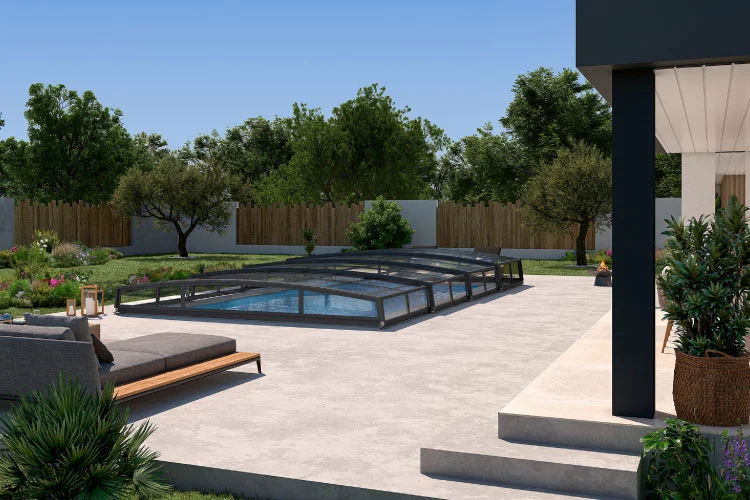
A retractable pool enclosure needs to fit the pool, deck, rails, modules, materials, movement path, climate exposure, and daily use. That is why a simple fixed price is rarely enough.
A quote may need to account for:
- Pool length and width
- Desired coverage area
- Enclosure height
- Number of enclosure modules
- Rail placement
- Rail cover options
- Deck condition
- Drainage
- Site access
- Delivery and staging
- Access door
- Roof and side-panel selections
- Manual or powered handling
- New build versus retrofit conditions
- Local approval requirements
We believe a good quote should be clear, practical, and specific. It should help you understand what is included, what is optional, and what may need additional site review.
Cost Variable 1 – Enclosure Size, Height, and Module Count
The first major cost variable is enclosure size. Larger enclosures usually require more structure, more panels, more rail length, more delivery planning, and more installation time.
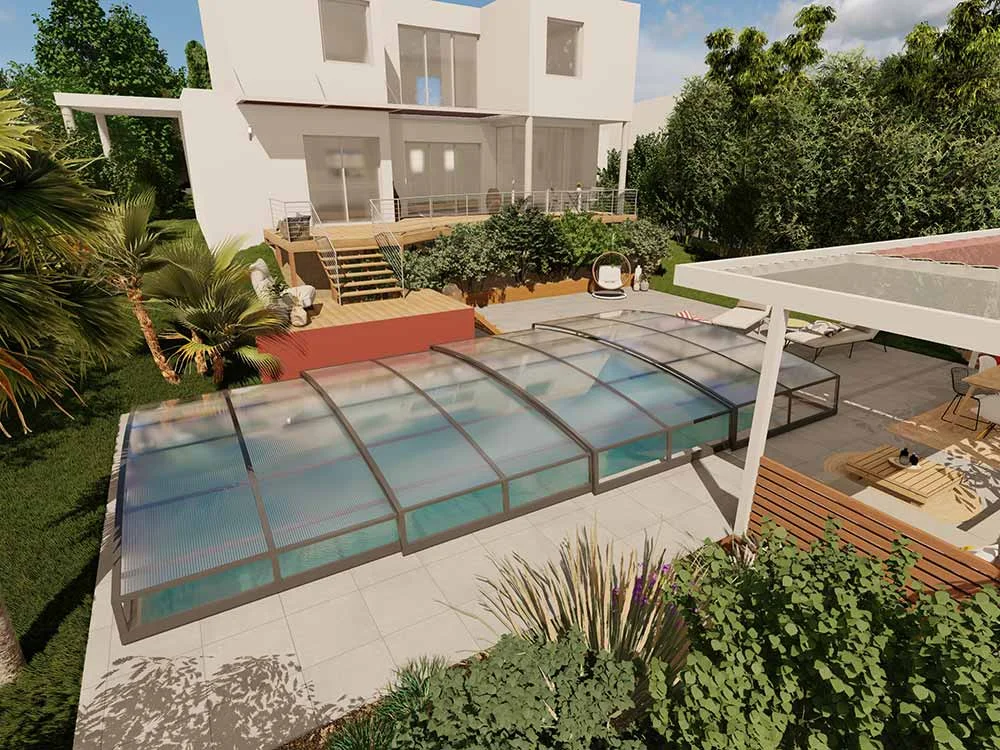
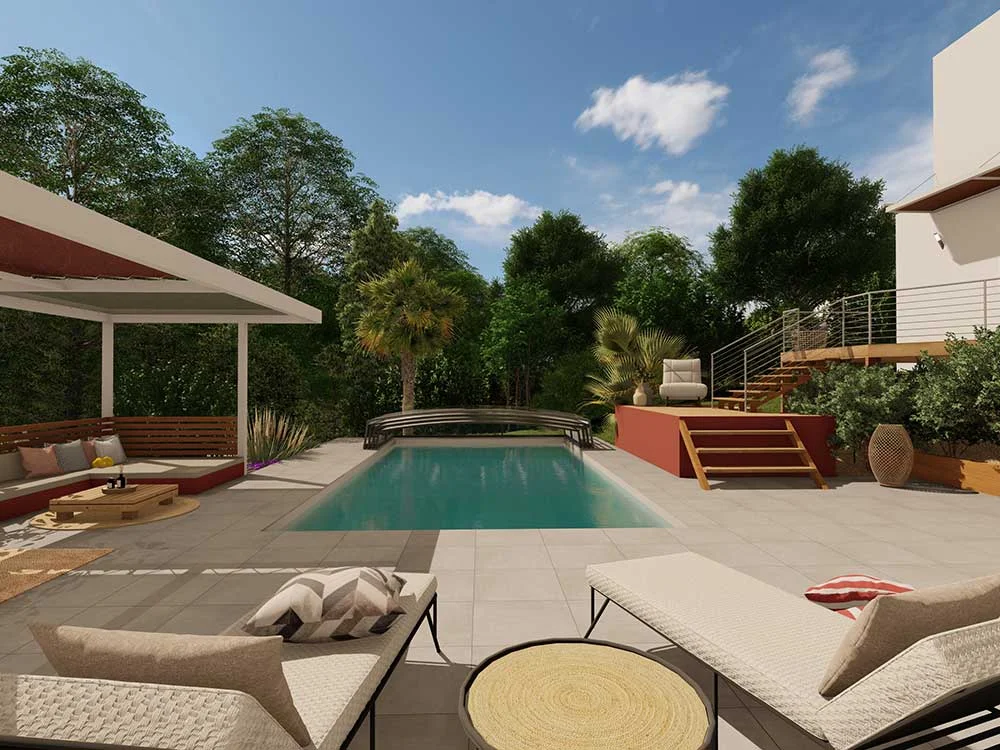
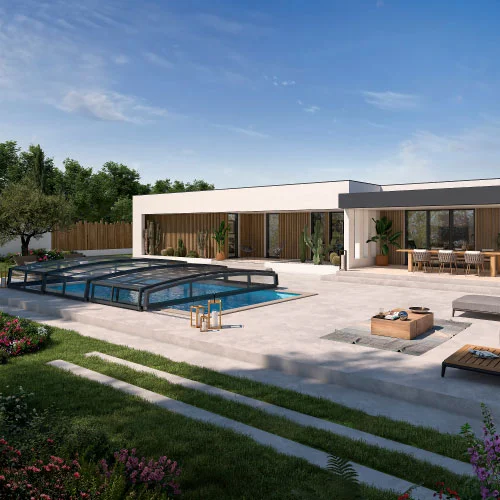
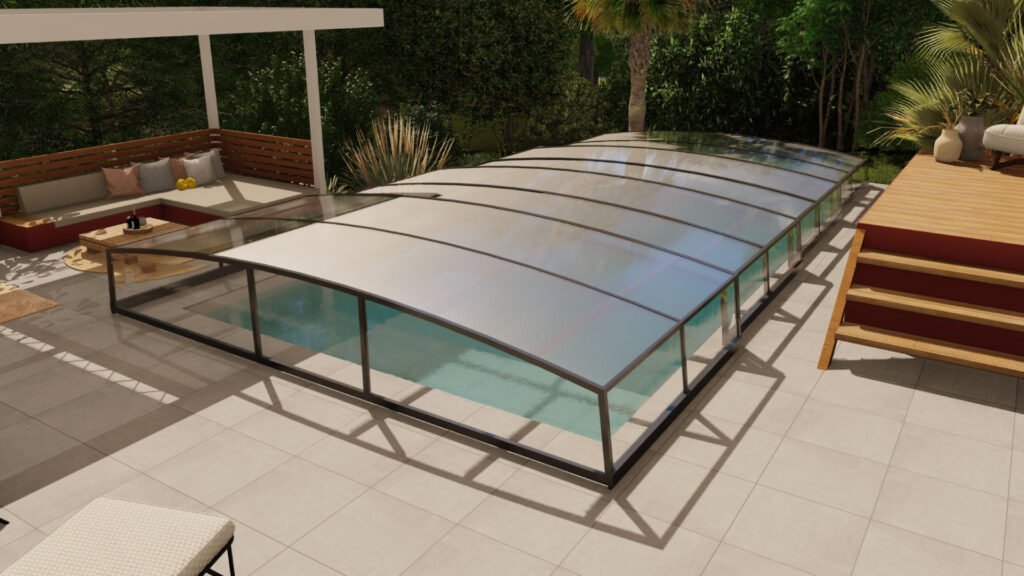
With N-CLOSURE retractable pool enclosure, Cover Dream describes a telescopic nested design that can cover or uncover one module of the pool at a time or the entire pool. The N-CLOSURE page also lists availability in 3-module, 4-module, and 5-module configurations.
Module count can affect:
- Frame material
- Polycarbonate panel quantity
- Rail length
- Movement path
- Installation time
- Delivery and handling
- Space needed at the end of the pool
Height also matters. A lower-profile enclosure may be less visually dominant. A taller or walk-in enclosure may feel more comfortable underneath but may need more material and more review depending on the site.
Helpful questions to ask include:
- What enclosure size is being quoted?
- What height/profile is included?
- How many modules are included?
- Does the quote cover partial or full pool coverage?
- Where do the modules stack or retract?
If the pool is a spa, swim spa, plunge pool, or compact heated pool, our guide to spa and plunge pool cover options can help you compare whether an enclosure, automatic cover, or sliding deck system fits the use case better.
Cost Variable 2 – Rail System and Movement Path
The rail system is one of the most important technical variables in a retractable pool enclosure quote.
Rails guide the enclosure modules as they move. The rail path needs to work with the deck, drainage, furniture, walls, landscaping, and available space.
Cover Dream lists N-CLOSURE options that include a rail with an easy-block system on each module and a rail cover. Buyers should confirm exactly how these options work and whether they are included or optional.
Important rail and movement questions include:
- Is the deck level enough for the rail system?
- Where will the modules move when the enclosure opens?
- Is there enough space at the end of the pool?
- Will furniture, planters, fences, or walls interfere?
- Is the rail cover included or optional?
- Is the easy-block rail option included or optional?
- Does the deck need preparation before installation?
Rail planning is especially important for finished yards. A new build often allows better coordination because the pool, deck, drainage, and enclosure can be planned together. A retrofit can still be possible, but existing hardscape may add complexity.
For buyers focused on appearance, our modern pool design guide is a useful supporting resource because rail visibility, hardware placement, and finish coordination can affect the final look.
Cost Variable 3 – Materials, Panels, and Roof Choices
Materials affect cost, appearance, durability, and daily performance.
Cover Dream describes N-CLOSURE as built with an aluminum structure and UV-treated polycarbonate. The page also describes transparent polycarbonate sides and lists a transparent roof as an available option.
For U.S. readers, the simplest way to describe the system is:
- Aluminum structure
- UV-treated polycarbonate roof
- Transparent polycarbonate side panels
- Optional transparent roof
- Optional rail cover
- Optional access door
Material-related quote questions include:
- What frame material is included?
- What roof material is included?
- Are the sides transparent?
- Is the transparent roof included or optional?
- What finish or color is included?
- What maintenance is required?
- What wind, snow, or weather assumptions apply?
A quote should specify the material system being offered. A proposal that only says “pool enclosure” may not give enough detail for a premium project.
Cost Variable 4 – Manual vs Motorized Retractable Enclosures
Manual and motorized retractable enclosures can have different pricing, convenience, and daily-use implications.
A manual system may be simpler. A motorized system may add convenience and encourage more consistent use. The right choice depends on pool size, module weight, user expectations, budget, and how often the enclosure will be opened or closed.
Cover Dream’s N-CLOSURE page mentions a solar-powered motor and states that the system can be handled easily by one person. It also says modules can be used to partially or fully uncover the pool.
For quote purposes, ask:
- Is the quoted system manual, motorized, or both?
- Is the solar-powered motor included?
- Can one person operate it?
- Can one module be opened at a time?
- Can the whole pool be uncovered?
- What maintenance is required for smooth operation?
- What controls or locking features are included?
Convenience is not only a luxury detail. It affects whether the enclosure will be used regularly.
Cost Variable 5 – Options and Accessories
Options can improve comfort, appearance, and usability, but they may affect the quote.
Cover Dream lists several N-CLOSURE options:
- Transparent roof
- Rail with easy-block system on each module
- Rail cover
- Access door
Transparent roof
A transparent roof may support a brighter, more open feeling. It may be relevant for buyers who want the enclosure to feel less visually heavy.
Rail with easy-block system
Cover Dream lists a rail with an easy-block system as an option. Buyers should ask how it functions, whether it is recommended for their enclosure size, and whether it is included or optional.
Rail cover
A rail cover may support appearance, comfort, or rail protection depending on the project. It should be reviewed with deck design and movement path.
Access door
An access door can improve convenience because users may not need to open the entire enclosure for every entry. Ask whether an access door is included, optional, or recommended for the planned layout.
A useful quote should separate standard features from optional upgrades. That helps buyers compare proposals accurately.
Ready to Price Your N-CLOSURE Project?
A better quote starts with better project details.
Low-Profile vs Walk-In Pool Enclosures
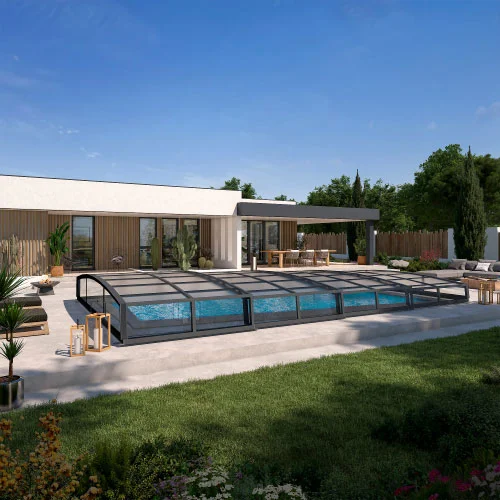
Enclosure height is both a design decision and a pricing variable.
Low-profile enclosure
A low-profile pool enclosure is usually less visually dominant. It can be a good fit for minimalist yards, modern pool designs, and homeowners who want protection without a large structure over the pool.
Potential advantages include:
- Cleaner appearance
- Lower visual impact
- Better fit for design-sensitive yards
- Less architectural presence
Potential tradeoffs include:
- Less standing room underneath
- Less comfort for swimming underneath
- Less indoor-room feeling
Walk-in or taller enclosure
A walk-in or taller pool enclosure may be better when comfort underneath the structure matters. It can feel more like a protected pool room or seasonal outdoor room.
Potential advantages include:
- More comfort under the enclosure
- Better usability while swimming
- More protected environment
- Stronger covered-pool experience
Potential tradeoffs include:
- More visible structure
- More material
- More design coordination
- Possible additional engineering, permitting, or HOA review
The right choice depends on whether the enclosure should visually recede or become a feature of the outdoor living space.
U.S. Permits, Engineering, Wind Load, Snow Load, Zoning, and HOA Review
U.S. buyers should think about approval and site requirements early.
This section is not legal advice. Requirements vary by city, county, state, HOA, climate, structure type, and installation scope. However, retractable pool enclosures may require review because they can function as outdoor structures.
Potential considerations include:
- Local building permits
- Structural engineering
- Wind-load requirements
- Snow-load requirements in colder regions
- Zoning setbacks
- HOA approval
- Easements
- Pool barrier rules
- Local contractor or installer requirements
- Electrical or solar-related review
- Site access for delivery and installation
N-CLOSURE should not be described as an ASTM F1346 safety cover unless project-specific compliance documentation is provided.
ASTM F1346 is relevant when discussing safety covers generally or documented safety-cover products such as Coverseal where the manufacturer’s page supports the claim. For more context, see our guide to the ASTM F1346 pool cover standard.
What a Retractable Pool Enclosure Quote Should Include
A strong quote should clearly define what is being priced. This helps buyers avoid comparing one complete proposal with another proposal that leaves out important work.
A quote should identify
- Enclosure dimensions
- Height/profile
- Number of modules
- Rail system
- Rail cover, if included
- Easy-block or locking rail option, if included
- Roof material
- Side panel material
- Transparent roof option, if selected
- Access door, if selected
- Manual or motorized operation
- Delivery assumptions
- Installation assumptions
- Site preparation assumptions
- Warranty details
- Maintenance expectations
- Exclusions
- Timeline assumptions
Items that may be excluded unless specified
- Permits
- Engineering
- HOA approval
- Zoning review
- Deck repair
- Deck leveling
- Drainage correction
- Electrical or solar-related site preparation
- Removal of old structures
- Landscaping restoration
- Crane or special access equipment
- Structural modifications
- Concrete or paver reconstruction
- Third-party contractor work
When comparing quotes, ask for a clear explanation of included and excluded items. A lower number may not be a better value if it leaves out important site preparation, delivery, installation, or approval requirements.
Cover Dream’s Pre-Quote Review Process
A better Cover Dream quote starts with better project information.
Before pricing N-CLOSURE, we may need to review:
- Pool dimensions
- Pool shape
- Site photos
- Pool plans or drawings
- Deck condition
- Desired enclosure height
- Module layout
- Rail path
- Movement clearance
- Site access
- Wind and weather exposure
- Debris concerns
- New build versus retrofit status
- Desired options
- Installation assumptions
This pre-quote review helps us clarify what is included, what may need additional site review, and whether N-CLOSURE is the correct product for the buyer’s climate, design goals, and use case.
A practical first question is:
Are we trying to protect the pool environment, cover the water surface, or reclaim usable deck space?
That answer helps determine whether N-CLOSURE, Coverseal, or S-LIDE is the better first option.
N-CLOSURE by Cover Dream: What Buyers Are Paying For
Our N-CLOSURE retractable pool enclosure is the main Cover Dream product match for buyers who want comfort, debris and weather protection, pool environment coverage, and a premium enclosure solution.
Based on the N-CLOSURE page, buyers are paying for:
- A retractable pool enclosure
- Telescopic nested design
- Module-based opening
- Ability to cover or uncover one module or the entire pool
- One-person operation
- Solar-powered motor
- Aluminum structure
- UV-treated polycarbonate roof
- Transparent polycarbonate side panels
- Weather and debris protection
- Enhanced pool cleanliness
- Comfortable swimming underneath
- Available 3-, 4-, and 5-module configurations
- Optional transparent roof
- Optional rail cover
- Optional rail with easy-block system
- Optional access door
N-CLOSURE is more than a basic cover. It is a retractable pool environment system.
It may be a strong fit when the buyer wants a more protected pool experience without choosing a fully fixed structure.
When a Retractable Pool Enclosure Is Worth the Cost
A retractable pool enclosure may be worth the cost when the buyer values comfort, pool cleanliness, weather protection, and a more usable pool environment.
Weather exposure
If the pool is exposed to rain, wind, or seasonal weather changes, an enclosure can help create a more protected pool area.
Debris control
If leaves, dust, pollen, or nearby landscaping create frequent cleaning issues, an enclosure can help reduce exposure.
Comfort
Cover Dream states that N-CLOSURE allows comfortable swimming underneath. That matters when the buyer wants the pool area to feel more usable in variable weather.
Cleanliness
Cover Dream states that N-CLOSURE enhances pool cleanliness. For buyers tired of constant skimming, this can be a meaningful benefit.
Longer swim season
A retractable enclosure may support more comfortable use in shoulder seasons or variable weather because it protects the pool environment. This is different from a water-surface cover, which is primarily used when the pool is closed.
Premium appearance
A retractable enclosure is visible, but that does not make it less premium. In the right project, it can become part of the pool architecture.
When Another Cover Type May Make More Sense
N-CLOSURE is not the best answer for every buyer. The right choice depends on the main goal.
Buyer goal | Better option to evaluate | Why |
Weather, debris, comfort, and pool environment coverage | Covers the pool environment and supports comfort, cleanliness, and weather/debris protection | |
Low-profile safety-oriented daily closure | Better fit when the buyer wants fast, low-profile water-surface coverage rather than an enclosure | |
Space optimization and pool-to-patio functionality | Better fit when the buyer wants usable deck space over the pool | |
Lower-cost limited coverage | Basic or seasonal cover | May help with limited heat/debris goals but usually lacks premium convenience or design integration |
Automatic safety pool cover
An automatic safety cover may make more sense when the buyer wants low-profile daily closure, reduced visual presence, and safety-oriented coverage rather than a visible enclosure.
Our automatic pool cover cost article can help readers understand how premium cover pricing is often shaped by pool size, track style, installation type, and design scope. That pricing should not be used as N-CLOSURE pricing; it is simply useful context for how quote variables work.
S-LIDE sliding deck pool cover
A sliding deck cover may make more sense when the buyer wants the pool area to become usable deck or patio space.
Our S-LIDE sliding deck pool cover is better aligned with space optimization, pool-to-patio functionality, and deck surface use. Buyers comparing that route should also review our guide to sliding deck pool cover cost and the article on pool deck cover with furniture.
Basic or seasonal cover
A basic or seasonal cover may make more sense when budget is the main priority and the buyer only needs limited debris or evaporation control. However, it will not provide the same pool environment coverage, comfort, or architectural presence as a retractable enclosure.
For compact yards, our guide to small backyard pool cover options may also be useful.
Quote Checklist – What to Share Before Requesting Pricing
A better quote starts with better project information. Before requesting pricing, prepare the following details.
Pool and coverage details
- Pool dimensions
- Pool shape
- Desired enclosure length
- Desired coverage area
- Full pool coverage or partial coverage
- Preferred height or profile
- Number of modules, if known
- New build or retrofit status
Site and deck details
- Deck material
- Deck condition
- Deck levelness
- Drainage conditions
- Grade changes
- Rail path
- Movement clearance
- Walls, fences, planters, or outdoor kitchens nearby
- Site access for delivery and installation
- Staging area availability
Environmental details
- Wind exposure
- Weather exposure
- Snow exposure, if applicable
- Debris concerns
- Nearby trees or landscaping
- Desired comfort level
- Heating or evaporation concerns
- Seasonal use goals
Options and usability
- Transparent roof preference
- Rail cover preference
- Easy-block rail preference
- Access door preference
- Manual or motorized operation preference
- One-person operation expectations
- Desired appearance and color direction
Supporting materials
- Photos from multiple angles
- Pool drawings or plans
- Deck layout
- Landscape plan, if available
- Budget range
- Timeline
- Primary goal: comfort, debris control, weather protection, cleanliness, safety-oriented closure, or longer usability
Before requesting a quote, it may also help to review our modern pool design guide if appearance and finish integration are important. For broader education, our pool cover blog can help buyers compare product types, safety considerations, and maintenance benefits.
Conclusion – A Better Quote Starts With Better Project Information
Retractable pool enclosure cost is quote-based because size, square footage, height, modules, rails, materials, options, site conditions, approvals, delivery, and installation scope all affect the final price. A single public number would not give most buyers enough detail to plan confidently.
For buyers who want comfort, debris and weather protection, pool environment coverage, easy operation, and premium appearance, N-CLOSURE retractable pool enclosure is the Cover Dream system to evaluate first.
For buyers who want low-profile daily safety-oriented closure, compare Coverseal automatic safety pool cover. For buyers who want pool-to-patio functionality and deck surface use, compare S-LIDE sliding deck pool cover.
After you request a quote, we can review your pool dimensions, site photos, preferred enclosure profile, module needs, rail path, options, and installation conditions. From there, we can clarify what is included, what may require
additional site review, and which system best fits your climate, design goals, and use case.

FAQs
Retractable pool enclosure cost is usually quote-based. Public U.S. market benchmarks vary widely, but N-CLOSURE pricing should be confirmed through a Cover Dream quote because size, modules, rails, materials, site conditions, options, and installation scope all affect the final number.
Cost per square foot can help with early planning, but it is only a starting point. Height, module count, rail system, material choices, motorization, site access, permitting, and installation assumptions can all change the final quote.
Cover Dream does not publish one fixed public N-CLOSURE price. Buyers should request a custom quote. Our Automatic Pool Cover Cost article can help explain quote variables, but automatic cover pricing should not be treated as N-CLOSURE pricing.
They may, depending on location, structure type, size, height, local code, HOA rules, and installation scope. U.S. buyers should ask about permits, engineering, zoning, setbacks, wind-load or snow-load review, and local contractor requirements before finalizing a quote.
They can. Wind and snow requirements may affect structure, engineering, materials, profile, installation assumptions, and local approval needs. Buyers in coastal, windy, mountain, or cold-weather regions should raise these questions early in the quote process.
A strong quote should identify enclosure dimensions, height/profile, module count, rail system, roof and panel materials, selected options, operation method, delivery assumptions, installation assumptions, site preparation assumptions, warranty details, maintenance expectations, and exclusions.
Possible exclusions include permits, engineering, HOA review, deck repair, drainage correction, electrical or solar-related site preparation, landscaping restoration, removal of old structures, crane or special access equipment, and third-party contractor work. Always ask for exclusions in writing.
Installation timing depends on enclosure size, module count, site access, deck readiness, delivery, local approvals, installer availability, and whether the project is a new build or retrofit. Ask Cover Dream what timeline assumptions apply to your specific project.
No. This article discusses retractable or telescopic pool enclosures, not conventional fixed Florida-style screen cages. Screen cages, fixed structures, and retractable enclosures may have different pricing models, materials, permitting needs, and performance goals.
Send pool dimensions, pool shape, site photos, desired enclosure length, preferred height/profile, rail path, deck condition, drainage notes, access constraints, desired options, wind or debris concerns, budget range, and project timeline.
