

Decision Table — Which Space-Saving Pool Cover Fits Your Yard?
The best small backyard pool cover depends on what you need most: more usable patio space, daily safety, debris control, comfort, or heat retention. A sliding deck pool cover can reclaim surface area, a retractable pool enclosure can protect the pool environment, and an automatic safety pool cover can provide low-profile daily protection.
Who this is for
- Homeowners with compact yards, plunge pools, spas, or narrow outdoor living areas.
- Pool buyers comparing space-saving options before construction or renovation.
- Builders, designers, and landscape architects evaluating Cover Dream premium pool cover systems for small backyard projects.
| Option | Best for | What it solves | Tradeoffs | Cover Dream match |
|---|---|---|---|---|
| Sliding deck pool cover | Reclaiming patio space | Turns the pool footprint into usable deck or patio area when closed | Requires layout planning, movement path, and structural coordination | S-LIDE™ sliding deck pool cover |
| Retractable pool enclosure | Comfort, debris, weather protection | Covers the pool environment, not only the water surface | More visually present than a low-profile cover; requires space for enclosure modules | N-CLOSURE retractable pool enclosure |
| Automatic safety pool cover | Low-profile daily protection | Helps secure, cover, and protect the pool quickly when not in use | Does not reclaim patio area like a deck cover; requires correct use and installation | Coverseal™ automatic safety pool cover |
| Solar / seasonal cover | Lower-cost temporary heat or debris help | Can reduce evaporation or provide seasonal protection in narrow use cases | Usually not design-integrated, space-saving, or safety-focused | Educational comparator only |
For small backyards, the key question is not simply “Which cover is best?” The better question is: Which problem are you solving first—space, safety, debris, comfort, or heat?
Why Small Backyard Pools Need a Different Cover Strategy
A large backyard can absorb mistakes. A small backyard cannot. When the pool, patio, furniture, landscaping, and walking paths all compete for limited space, the cover system becomes part of the outdoor living design—not just an accessory.
Small backyard pool projects often involve:
- Limited patio or deck area around the pool
- Narrow circulation paths
- Tight furniture layouts
- Limited storage for manual covers
- Shorter distances between the pool, home, and seating areas
- More concern about children, pets, or guests near the water
- Greater need to keep the pool clean without daily maintenance friction
- Stronger pressure to make every square foot useful
This is why a pool cover for small backyard designs should be chosen by function. A homeowner who wants more entertaining area may need a deck-style solution. A buyer who wants better comfort and debris protection may need an enclosure. Someone who wants a clean, low-profile daily safety layer may prefer an automatic safety cover.
Option 1 — Sliding Deck Pool Cover: Best for Reclaiming Patio Space
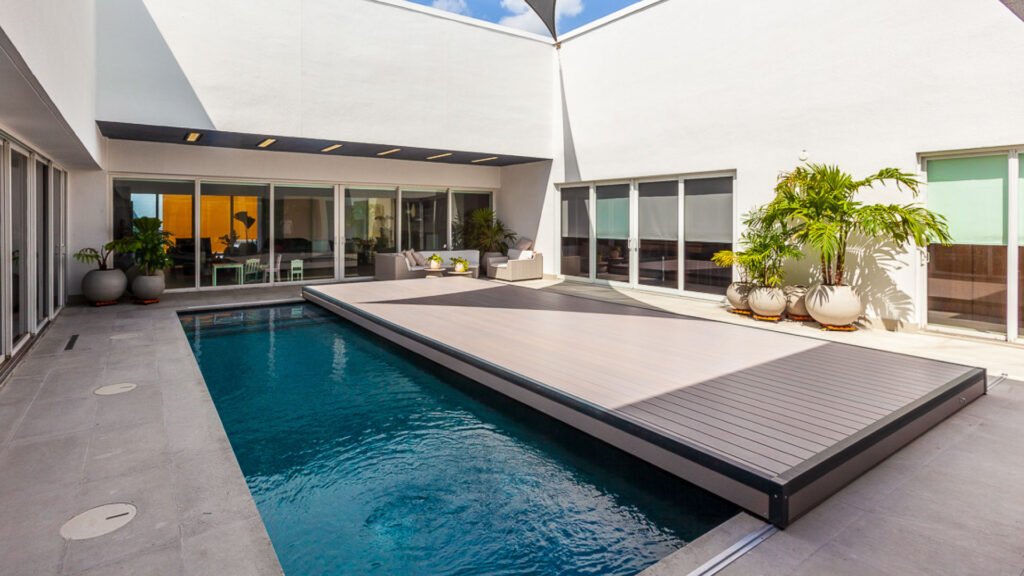
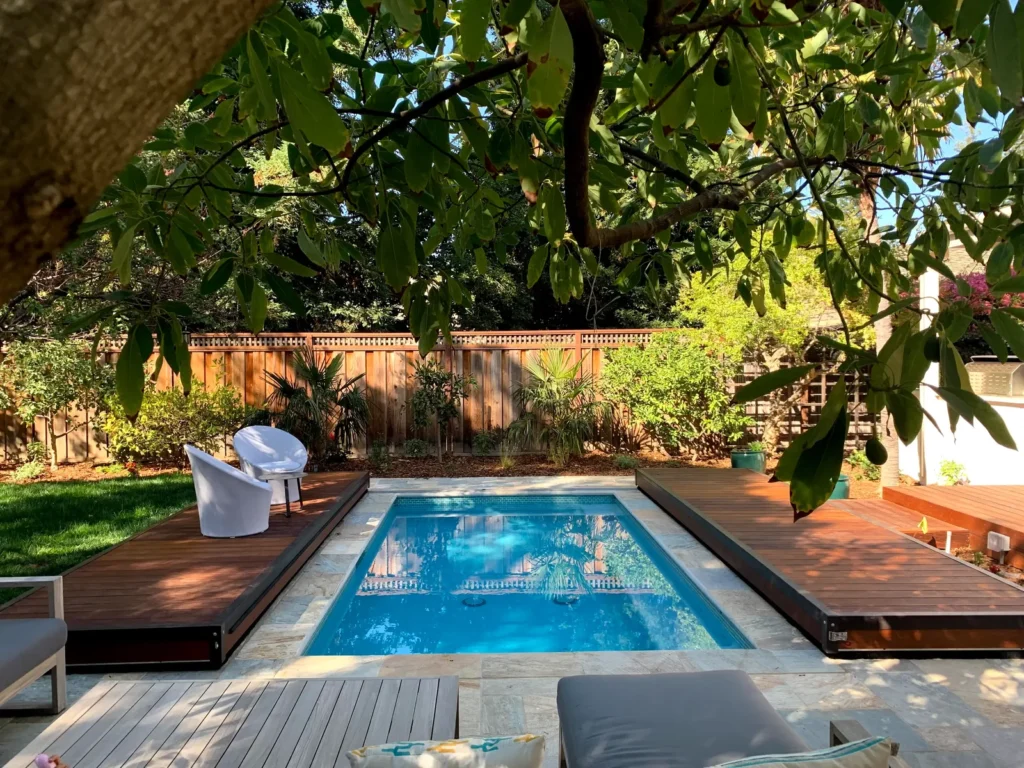
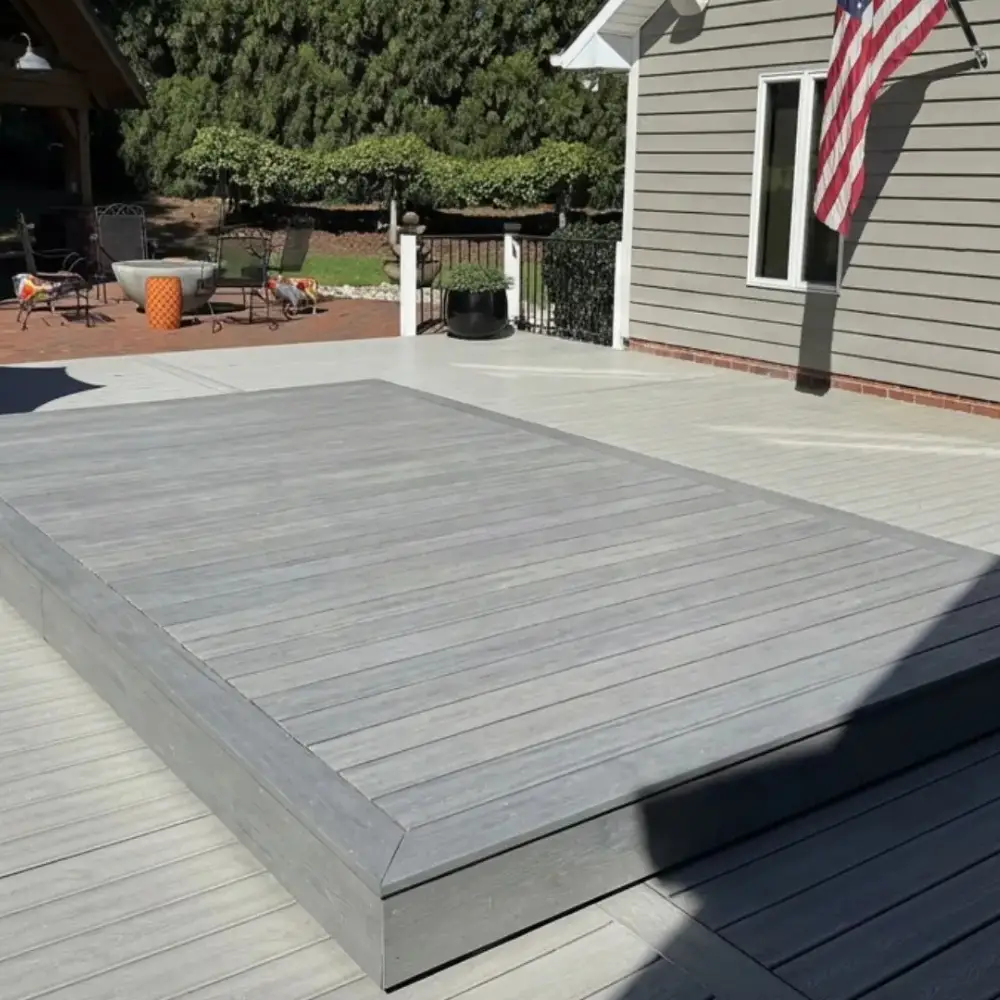
A sliding deck pool cover is the most space-transforming option because it changes what the pool footprint can do. Instead of only covering the water, a deck-over-pool system creates usable surface area when the pool is closed.
For a small yard, that is a major design advantage. The pool can function as a water feature when open and as patio/deck space when closed. This is especially useful for:
- Plunge pools
- Compact luxury pools
- Courtyard pools
- Urban backyards
- Outdoor entertaining areas with limited patio space
- Homes where furniture layout is constrained by the pool footprint
Cover Dream match: S-LIDE™ sliding deck pool cover
Cover Dream’s S-LIDE™ sliding deck pool cover is designed as a two-in-one sliding pool cover, patio, and deck solution. Cover Dream states that S-LIDE helps make the most of pool-area square footage, supports high loads, can accommodate patio furniture, and is available with solar-powered motorized operation for push-button use.
That makes S-LIDE a strong fit when the buyer is searching for a space saving pool cover, rolling deck pool cover, motorized pool deck cover, or pool cover to save space.
Best-fit cases
S-LIDE is worth evaluating when:
- The pool takes up most of the available patio area.
- The homeowner wants to host guests without sacrificing pool access.
- The design goal is to turn the pool footprint into usable deck space.
- The pool area needs to feel more flexible day to day.
Watchouts
A sliding deck is a premium structural solution. It is not the simplest or lowest-cost cover category. The project must allow for:
- A clear movement path
- Structural planning
- Deck surface coordination
- Furniture layout review
- Proper access for installation
For small yards, this planning is not a weakness. It is the point. A deck-style cover can solve space in a way a fabric cover cannot.
Option 2 — Retractable Pool Enclosure: Best for Comfort, Debris, and Weather
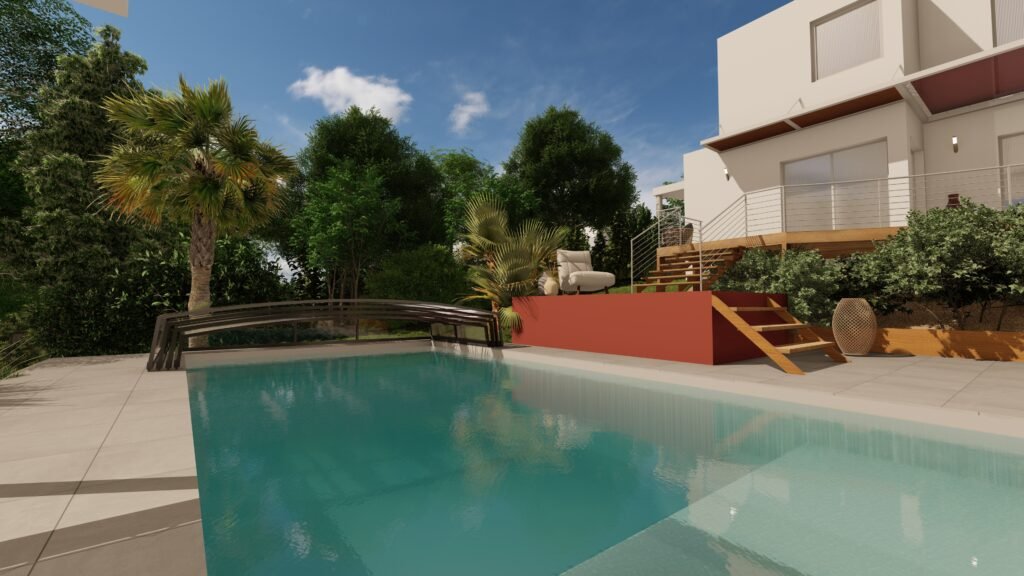
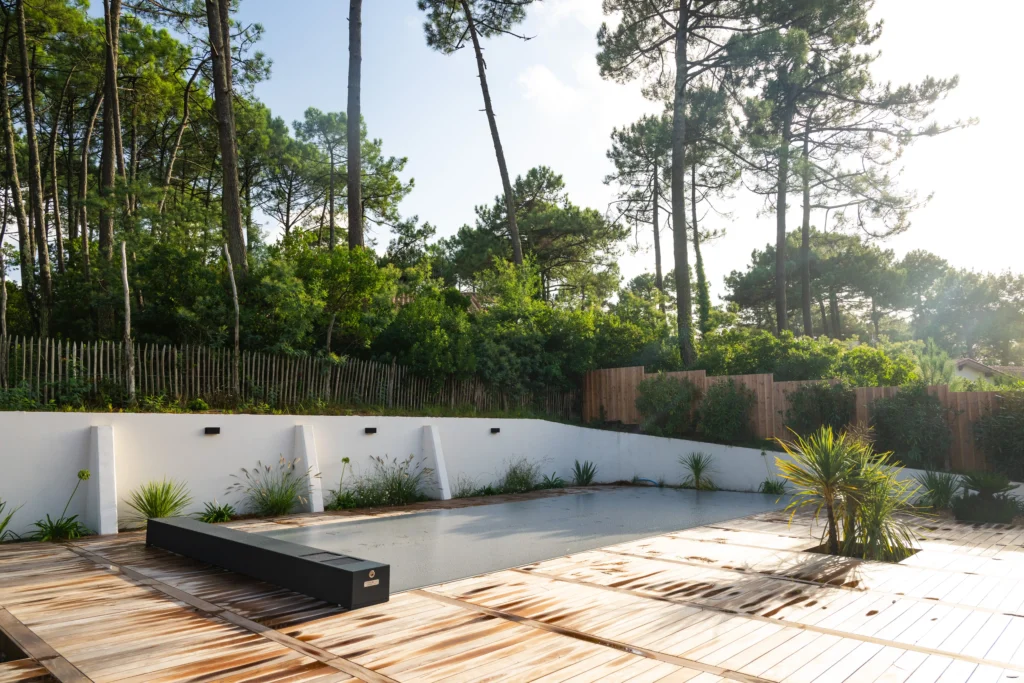
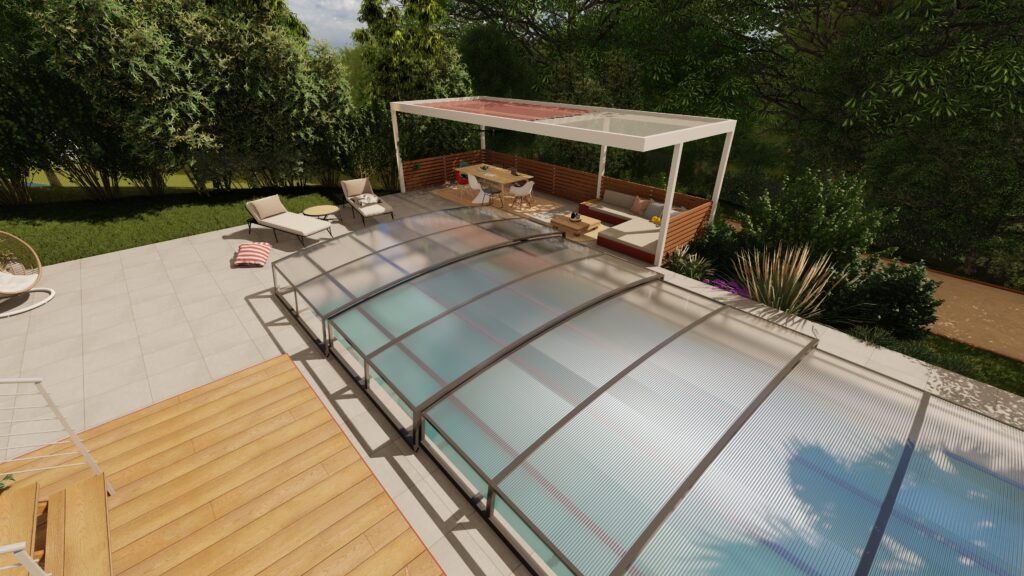
A retractable pool enclosure solves a different problem. It does not primarily reclaim patio surface like a sliding deck. Instead, it covers the pool environment.
That can be valuable in a small backyard because debris, wind, and weather exposure often feel more concentrated. Leaves from nearby trees, dust from surrounding surfaces, or wind-driven debris can make a small pool feel harder to maintain than expected.
An enclosure can be useful when the goal is:
- More protected swimming conditions
- Less debris entering the pool
- Improved comfort around the water
- Weather protection
- Easier pool cleanliness
- More usable swim time in changing conditions
Cover Dream match: N-CLOSURE retractable pool enclosure
Cover Dream’s N-CLOSURE retractable pool enclosure is presented as a telescopic pool enclosure that can cover or uncover one module at a time or the entire pool. Cover Dream states that it can be handled easily by one person and glides open and closed manually on a frictionless aluminum track. Solar heat is trapped passively to warm the water — it is not used to power the enclosure’s movement.
Cover Dream also describes N-CLOSURE as allowing comfortable swimming underneath and enhancing pool cleanliness. For buyers searching for a pool enclosure for small backyard, retractable pool enclosure, or small pool cover ideas focused on comfort and debris control, N-CLOSURE is a logical option to compare.
Best-fit cases
N-CLOSURE is worth evaluating when:
- The yard has heavy leaves, dust, or wind exposure.
- The homeowner wants a more protected pool environment.
- Comfort and cleanliness matter more than reclaiming patio space.
- A visible architectural enclosure fits the design.
Watchouts
An enclosure is more visually present than a low-profile automatic cover. It must be reviewed against:
- Yard dimensions
- Property lines
- Deck layout
- Landscape design
- Visual preference
- Movement/operation space
For some small yards, an enclosure can make the pool feel more usable. For others, it may feel too prominent. The right answer depends on the site.
Protect your loved Ones!
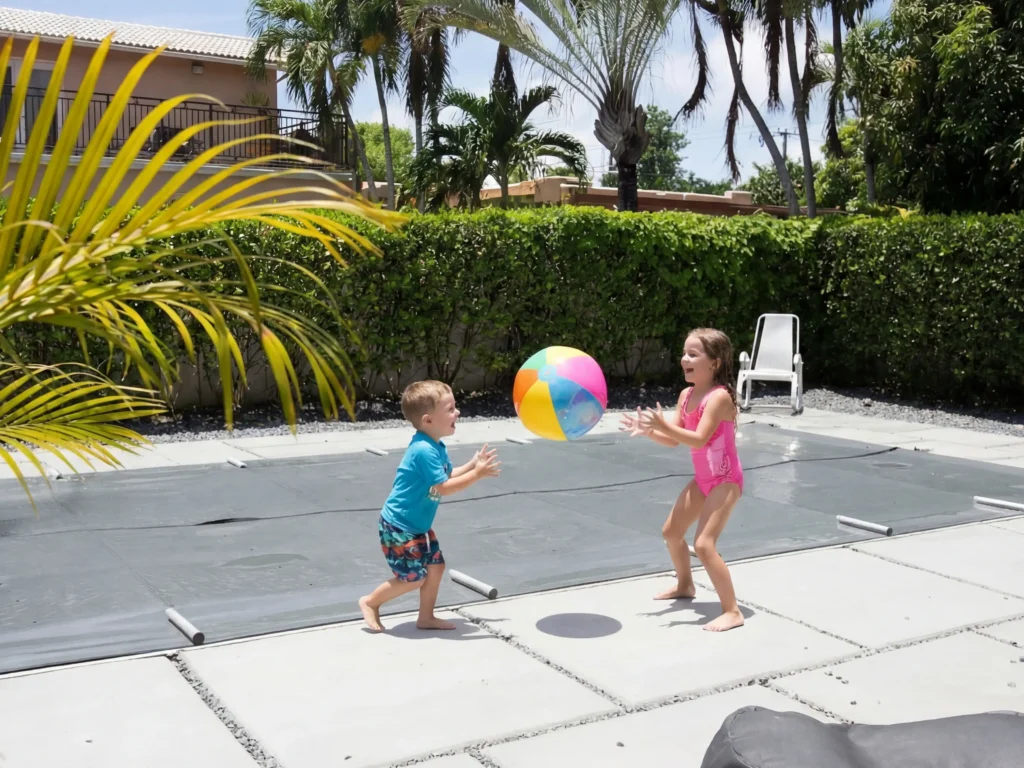
A pool cover is the most efficient barrier against accidental drownings. Get your pool covered.
Option 3 — Automatic Safety Cover: Best for Low-Profile Daily Protection
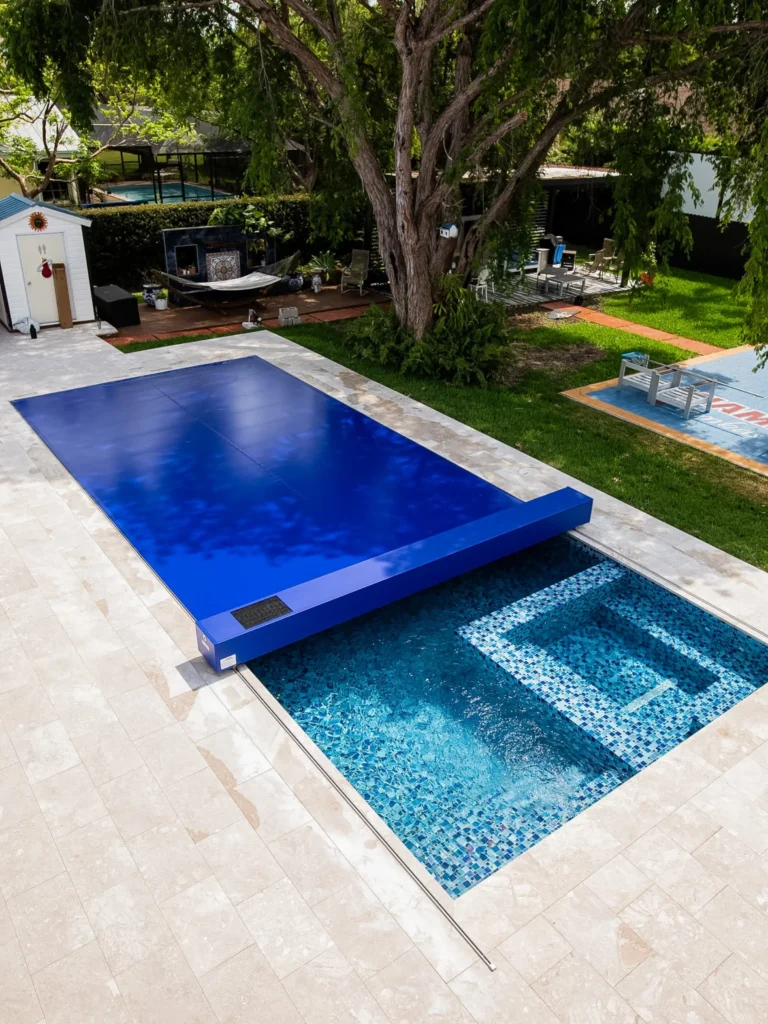
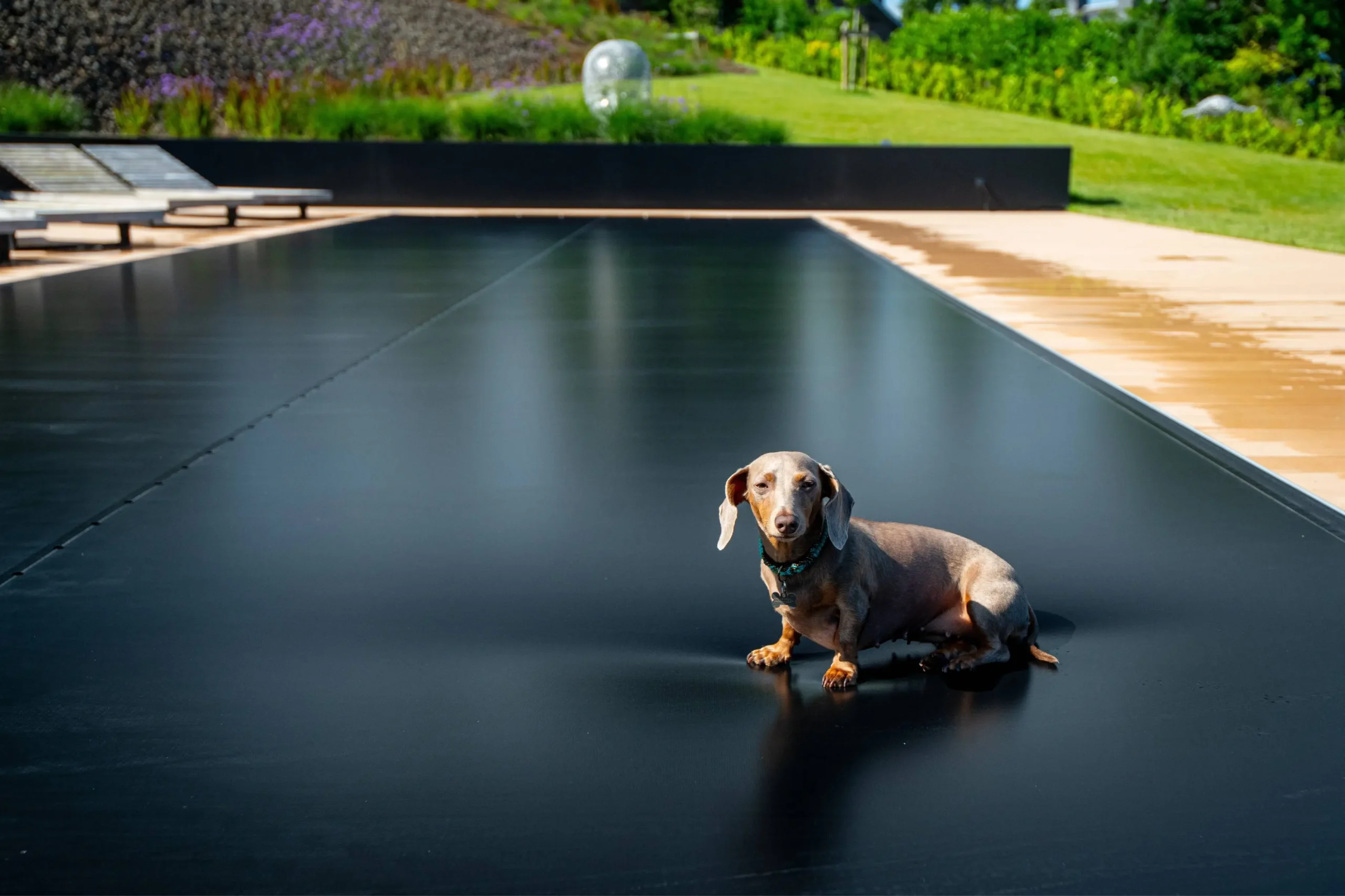
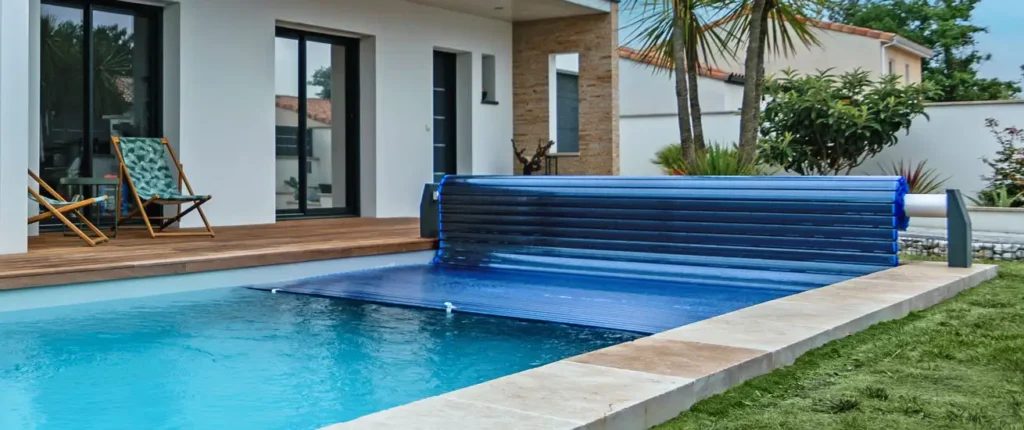
An automatic safety pool cover is often the best option when the homeowner wants daily coverage without changing the look and use of the backyard as much as a deck or enclosure.
For compact spaces, this matters. A small yard may not have room for a large enclosure or deck movement path. In that case, a low-profile automatic cover can help protect the pool when not in use while preserving open patio space.
Safety framing: ASTM F1346
For safety-oriented cover decisions, ASTM F1346 is the key reference. ASTM describes the specification as intended to reduce drowning risk by inhibiting access to the water by children under five when correctly installed and used according to the manufacturer’s instructions.
That careful language matters. A cover should not be treated as a substitute for supervision or local safety requirements. It should be understood as one layer of protection when installed and used properly.
Cover Dream match: Coverseal™ automatic safety pool cover
Cover Dream’s Coverseal™ automatic safety pool cover is positioned as an automatic safety pool cover with fast operation, safety-oriented coverage, and benefits related to water quality, temperature stability, and evaporation reduction.
Cover Dream states that Coverseal can open or secure a pool in under a minute, operates by wired or wireless control, and uses solar-powered batteries built into the casing. The page also states that the system meets safety standards including ASTM F1346.
Best-fit cases
Coverseal is worth evaluating when:
- The homeowner wants daily safety-oriented coverage.
- The yard must remain visually open.
- The buyer wants a low-profile solution rather than a visible enclosure.
- Fast opening and closing matter.
- The goal includes debris reduction, evaporation reduction, and cleaner water.
Watchouts
An automatic safety cover does not reclaim patio space like a sliding deck. It also depends on correct use. The cover only performs when it is closed, maintained, and used according to the manufacturer’s instructions.
For many small yards, however, the low-profile appearance and daily convenience make it a strong option.
Other Signature Series Options Worth Knowing
Space isn’t the only priority for every small yard. Two other Cover Dream systems are worth a quick mention even though they aren’t primarily space-saving.
B-COVER skips the track system entirely, tensioning by hand with fiberglass support bars instead of a motor — the certified safety rating stays, the price tag drops. Worth a look if the budget line matters more than one-touch convenience.
S-ROLL goes the opposite direction: motorized slats, no manual step, plus an optional solar-heating upgrade that warms the water passively while closed. It’s the pick when automation and heat control matter more than a safety rating or reclaiming the patio.
Neither changes the space equation the way S-LIDE, N-CLOSURE, or Coverseal do, but both are worth a look if your main goal isn’t space.
What About Solar Blankets, Leaf Nets, and Seasonal Covers?
Solar blankets, leaf nets, and seasonal covers can be useful, but they should be viewed clearly.
Solar blankets
A solar blanket can help reduce evaporation and heat loss. The U.S. Department of Energy explains that swimming pool covers reduce evaporation and that covering a pool when not in use is the single most effective way to reduce pool heating costs.
However, solar blankets do not reclaim patio space. They are typically manual, require handling and storage, and are not usually premium design-integrated solutions.
Leaf nets
Leaf nets can help in debris-heavy seasons, especially if the pool is near trees. But they are narrow-purpose. They do not solve safety, heat retention, daily convenience, or space optimization in the same way premium systems can.
Seasonal covers
Seasonal covers may work for off-season protection, but they are not typically the best option for homeowners who want daily convenience, high-end outdoor design, or a compact yard that needs to remain usable throughout the week.
For a small backyard, the limitation is simple: lower-cost covers may cover the water, but they usually do not improve how the backyard functions.
Heat, Evaporation, and Maintenance Benefits
Even when space is the main goal, heat, water, and maintenance matter.
The U.S. Department of Energy states that covering a pool when it is not in use is the single most effective way to reduce pool heating costs, with possible savings of 50%–70% depending on conditions.
EPA WaterSense also states that pool covers can prevent up to 95% of pool water evaporation. Its archived pool cover guidance notes that a typical uncovered pool can lose 12,000 to 31,000 gallons of water per year to evaporation depending on location: EPA WaterSense Pool Covers.
EPA also notes that pool covers can reduce cleaning requirements and chemical use. That matters for compact pools because smaller water volumes can be more sensitive to debris and usage patterns.
The practical lesson is straightforward: a cover only delivers benefits when it is used consistently. A premium system that is easy to open and close may outperform a cheaper cover that stays folded in storage.
How to Choose Based on Your Main Goal
Use this matrix to narrow your choice before requesting a quote.
| Main goal | Best option to evaluate first | Why |
|---|---|---|
| Need more patio space | S-LIDE sliding deck pool cover | Converts the pool footprint into usable deck/patio area when closed |
| Need comfort, weather, and debris control | N-CLOSURE retractable pool enclosure | Covers the pool environment rather than only the water surface |
| Need daily safety and low-profile design | Coverseal automatic safety pool cover | Provides automatic coverage while keeping the yard visually open |
| Need low-cost temporary heat/debris help | Solar, leaf, or seasonal cover | Can solve narrow needs but does not transform backyard function |
If the yard is very small, begin with the space question. If the pool occupies the main patio footprint, S-LIDE may deserve first review. If the pool already fits well but debris and comfort are the issue, N-CLOSURE may be more relevant. If daily safety and low-profile coverage matter most, Coverseal is the stronger starting point.
Quote Checklist for a Small Backyard Pool Cover
Before requesting a quote, collect the following information.
Pool and patio dimensions
- Pool length and width
- Pool shape
- Spa or plunge pool dimensions
- Deck or patio dimensions around the pool
- Distance from pool edge to walls, fences, landscaping, and seating areas
Space and movement
- Available movement path for a sliding deck
- Furniture layout
- Walking/circulation paths
- Gate and equipment access
- Tight side-yard constraints
Site conditions
- Sun exposure
- Wind exposure
- Leaf/debris exposure
- Nearby trees or structures
- Drainage conditions
- New build or retrofit status
Technical details
- Electrical access
- Pool equipment location
- Desired cover operation method
- Whether the cover should be low-profile, structural, or enclosure-based
- Photos, drawings, and timeline
Primary goal
Rank your top priority:
- Space optimization
- Safety-oriented daily coverage
- Debris reduction
- Heat retention
- Comfort and weather protection
- Low-cost temporary coverage
A good quote depends on a clear goal. Without that, every system may sound appealing, but not every system will solve the right problem.
Conclusion — The Best Small Backyard Pool Cover Depends on the Goal
There is no single best small backyard pool cover for every home. The right system depends on what your small yard needs to do.
If your priority is space optimization, compare a S-LIDE sliding deck pool cover. It is the most direct option when the pool footprint needs to become usable patio or deck space.
If your priority is comfort, debris control, and weather protection, compare an N-CLOSURE retractable pool enclosure. It may be the stronger option when the goal is to protect the pool environment.
If your priority is daily safety-oriented coverage and low-profile design, compare a Coverseal automatic safety pool cover. It is especially relevant when the yard must remain open and visually clean.
If space isn’t your main concern, B-COVER and S-ROLL are also part of the Signature Series and worth a look on the compare page.
A restrained next step is to request a quote and provide your pool dimensions, photos, deck layout, access constraints, and top priority. The more clearly you define the problem — space, safety, debris, heat, or comfort — the more useful the recommendation will be.
FAQs
The best pool cover for a small backyard depends on the main goal. For maximum usable patio space, a sliding deck cover is often strongest. For comfort and debris protection, consider an enclosure. For low-profile daily safety-oriented coverage, compare an automatic safety cover.
Yes. A sliding deck pool cover can save space by turning the pool footprint into usable patio or deck area when closed. Cover Dream’s S-LIDE sliding deck pool cover is designed as a two-in-one pool cover, patio, and deck solution.
It can be, especially if the small yard has debris, wind, or comfort problems. A retractable enclosure covers the pool environment rather than only the water surface. Cover Dream’s N-CLOSURE can cover or uncover pool modules partially or fully.
Yes, an automatic safety cover can be a strong option for a small pool when the owner wants low-profile daily protection and fast operation. Cover Dream’s Coverseal automatic safety pool cover is positioned for fast opening/closing and safety-oriented coverage.
For a plunge pool, the best cover depends on whether the priority is space, safety, or comfort. A sliding deck can help reclaim patio area, an automatic cover can provide low-profile daily coverage, and an enclosure can help with comfort and debris control.
Yes. EPA WaterSense states that pool covers can prevent up to 95% of pool water evaporation. This can also reduce the need to replace water and help stabilize maintenance routines when the cover is used consistently.
Yes. The U.S. Department of Energy states that covering a pool when it is not in use is the single most effective way to reduce pool heating costs, with possible savings of 50%–70% depending on conditions.
Measure pool length, width, shape, deck/patio dimensions, movement paths, distance to walls or landscaping, and available access. Also note furniture layout, sun/wind/debris exposure, electrical access, and whether the project is a new build or retrofit.
Solar blankets can help reduce evaporation and heat loss, but they usually do not reclaim patio space, provide premium design integration, or offer safety-oriented daily coverage. They may be useful as a lower-cost temporary option, but they are not the same as a structural or automatic cover.
