

Freeform, No Edge, and Complex Pools: Which Cover Systems Actually Work?
Many freeform, no-edge, kidney-shaped, and complex pools can be covered, but the right solution depends on shape, edge type, track strategy, deck layout, and your primary goal. A pool cover for freeform pool designs must be planned around the real geometry—not treated like a standard rectangle. One exception: vanishing-edge (infinity-edge) pools, where water overflows a negative edge, fall outside what Cover Dream’s Signature Series can cover.
Who this is for
- Homeowners and pool buyers with a freeform, kidney-shaped, or no-edge (flush-coping) pool.
- Pool builders, landscape architects, and luxury outdoor-living designers planning a complex pool.
- Buyers comparing an automatic safety pool cover, sliding deck pool cover, retractable pool enclosure, slatted automatic cover, or manual trackless safety cover from Cover Dream premium pool cover systems.
Decision Table — Which Cover System Works for Your Pool Type?
| Pool challenge | Best system to evaluate first | Why it works | Watchouts | Cover Dream match |
|---|---|---|---|---|
| Freeform pool | Automatic safety cover or custom cover strategy | Irregular pools can often be covered if the track and housing approach are planned correctly. | Track visibility, edge curves, deck work, and quote complexity | Coverseal™ automatic safety pool cover |
| Kidney-shaped pool | Automatic cover or sliding deck cover | A kidney-shaped pool may be coverable, but the curve usually requires custom planning rather than a standard rectangular approach. | Custom fitting, track route, housing placement | Coverseal™ or S-LIDE™ |
| No-edge / flush-edge pool | Case-by-case evaluation: automatic cover, enclosure, or deck system | Flush edges can be architecturally clean but technically demanding because there may be limited room for tracks, drainage, or housing. | Edge detail, overflow channels, drainage, aesthetics | Coverseal™ |
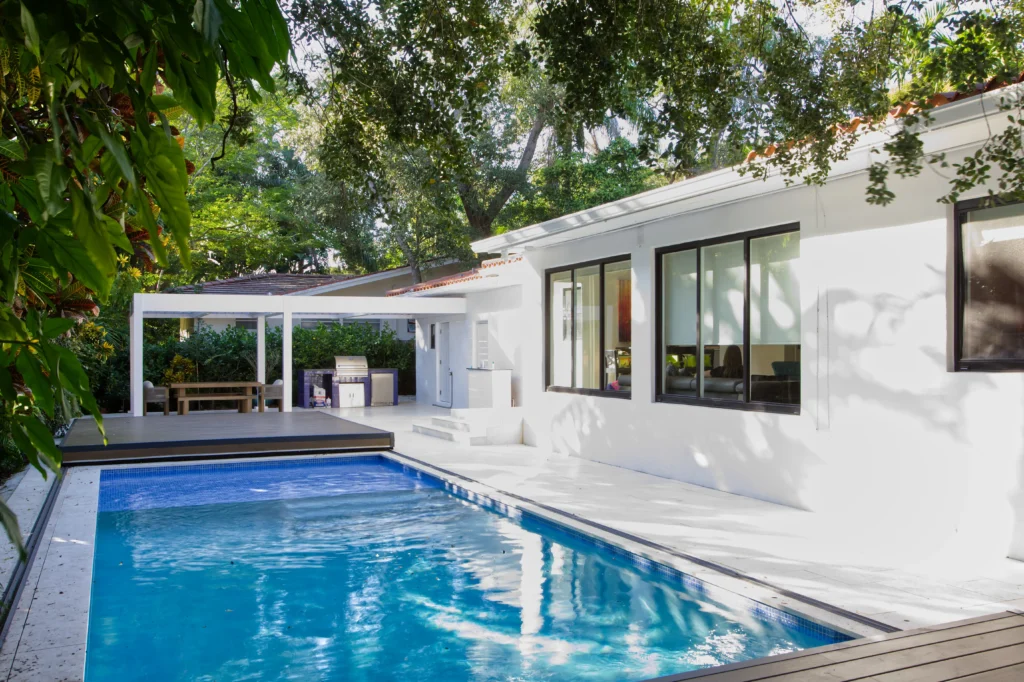
| Small backyard pool | Sliding deck pool cover | A deck-over-pool approach can turn the pool footprint into a usable patio or entertaining space. Cover Dream describes S-LIDE as a two-in-one sliding pool cover, patio, and deck solution. | Requires movement area, structural planning, and layout review | S-LIDE™ sliding deck pool cover |
| Pool with heavy leaves/debris | Retractable pool enclosure or automatic safety cover | An enclosure covers the pool environment; an automatic cover protects the water surface when closed. | Enclosure visibility, daily use habits, wind exposure | Coverseal™ |
| Complex luxury pool with strong design requirements | Design-stage comparison of all three systems | The best system may be the one that protects safety, aesthetics, and usability together—not simply the lowest-cost cover. | Early coordination is critical | Cover Dream premium pool cover systems |
Why Freeform and Complex Pools Are Harder to Cover
A rectangular pool is straightforward because the cover, tracks, and housing can usually follow predictable lines. Complex pools are different. A freeform pool cover must account for curves, angles, raised details, and non-standard edge conditions.
Common challenges include:
- Curved or kidney-shaped geometry
- Vanishing-edge (infinity-edge) overflow details — not something Cover Dream’s product line currently covers
- Flush/no-edge coping
- Raised spas or attached hot tubs
- Tanning ledges, benches, or steps
- Narrow deck areas around the pool
- Limited space for cover housing
- Drainage and overflow management
- Aesthetic expectations around visible tracks or equipment
The key issue is not whether the pool is “complex.” The issue is whether the cover system has a realistic path for the cover, tracks, housing, drainage, and operation. Latham’s guidance on automatic pool covers for every pool shape supports this practical view: irregular pools may be coverable, but the track option and project design drive feasibility.
For a luxury project, this is where early planning becomes valuable. If the cover is considered only after the pool shell, coping, deck, and overflow details are complete, the available options may become narrower, more visible, or more expensive.
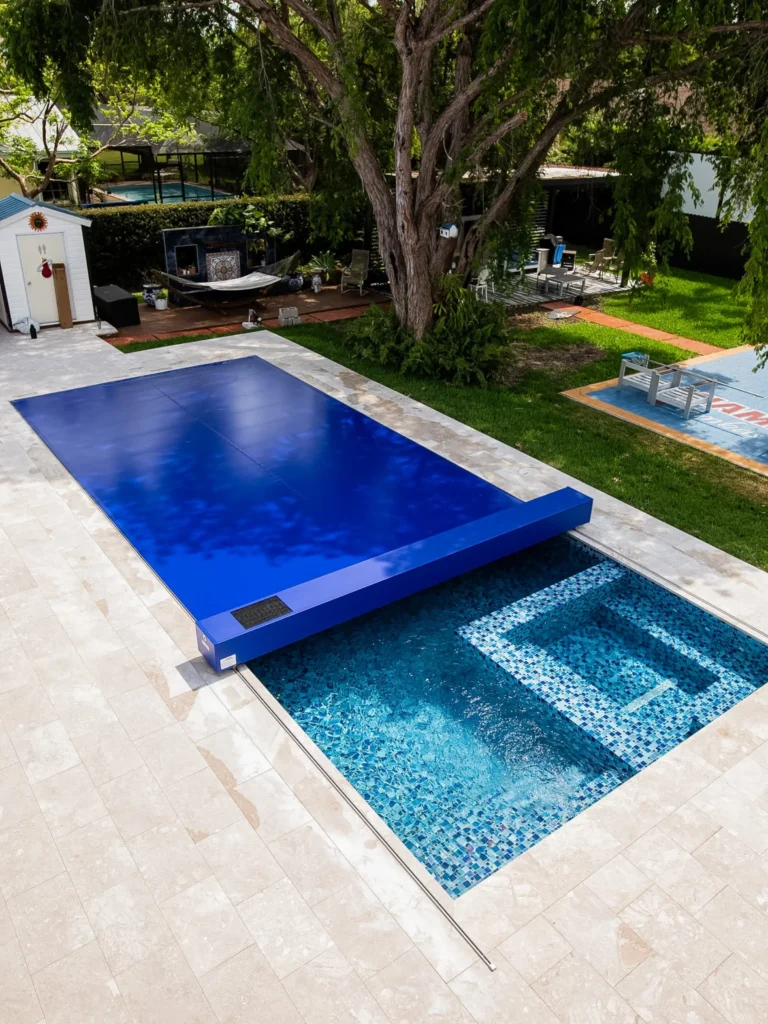
Protect your loved Ones!
A pool cover is the most efficient barrier against accidental drownings. Get your pool covered.
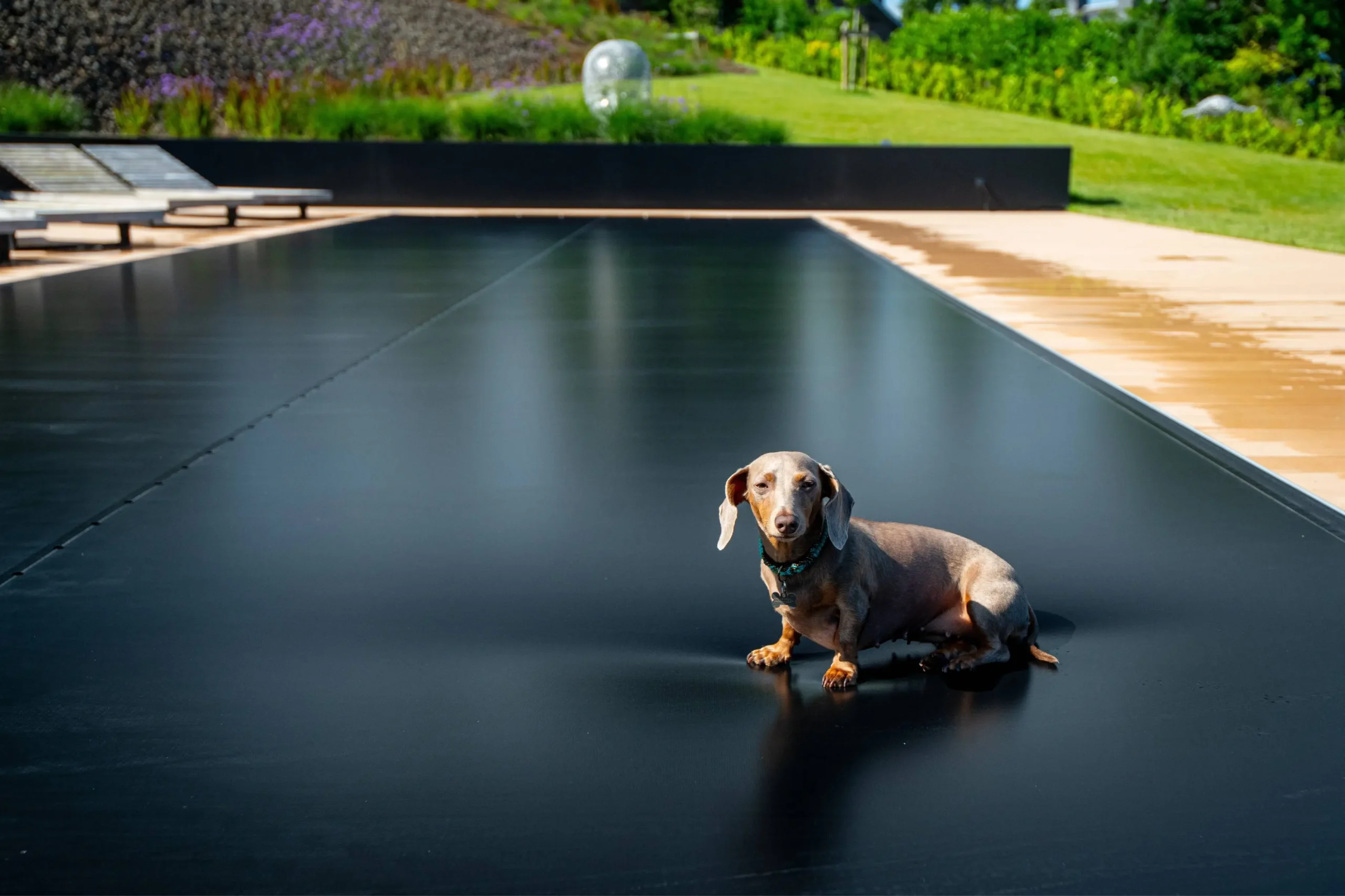
Option 1 — Automatic Safety Covers for Freeform and Irregular Pools
An automatic pool cover for freeform pool designs can work in many cases, but it depends on the track strategy and the edge condition. The cover must be able to travel cleanly, secure properly, and close in a way that matches the intended performance.
For safety-focused buyers, ASTM F1346 is the key safety-cover reference. ASTM describes the safety-cover specification as intended to reduce drowning risk by inhibiting access to the water by children under five when correctly installed and used according to manufacturer instructions.
That language matters. It does not mean any product that “covers the pool” is a safety cover. It means the system must be designed, installed, and used as a safety cover.
Cover Dream match: Coverseal™ automatic safety pool cover
Cover Dream’s Coverseal™ automatic safety pool cover page states that the system uses a patented mechanism, locks into extra-flat tracks, and uses a pre-stressed PVC membrane designed for UV resistance and demanding safety/pool protection standards, including ASTM F1346.
Cover Dream also states that Coverseal™ supports the weight of individuals, including children and pets, and is designed to provide protection for pool sizes and shapes. For homeowners comparing a custom pool cover for irregular pool designs, this makes Coverseal™ the first Cover Dream system to evaluate when the main priority is safety and daily automatic closure.
Best fit
- Safety is the primary concern.
- Daily opening and closing convenience matters.
- The pool shape can be addressed with an appropriate track and housing plan.
- The buyer wants a premium automatic safety cover rather than a manual seasonal cover.
Watchouts
- Complex curves may require custom planning.
- Track visibility should be discussed early.
- No-edge (flush-coping) pools require careful review before assumptions are made. Vanishing-edge (infinity-edge) pools are not something Cover Dream’s systems can accommodate at all.
- New construction usually offers more design flexibility than retrofit installation.
Option 2 — Sliding Deck Pool Covers for Space and Difficult Shapes
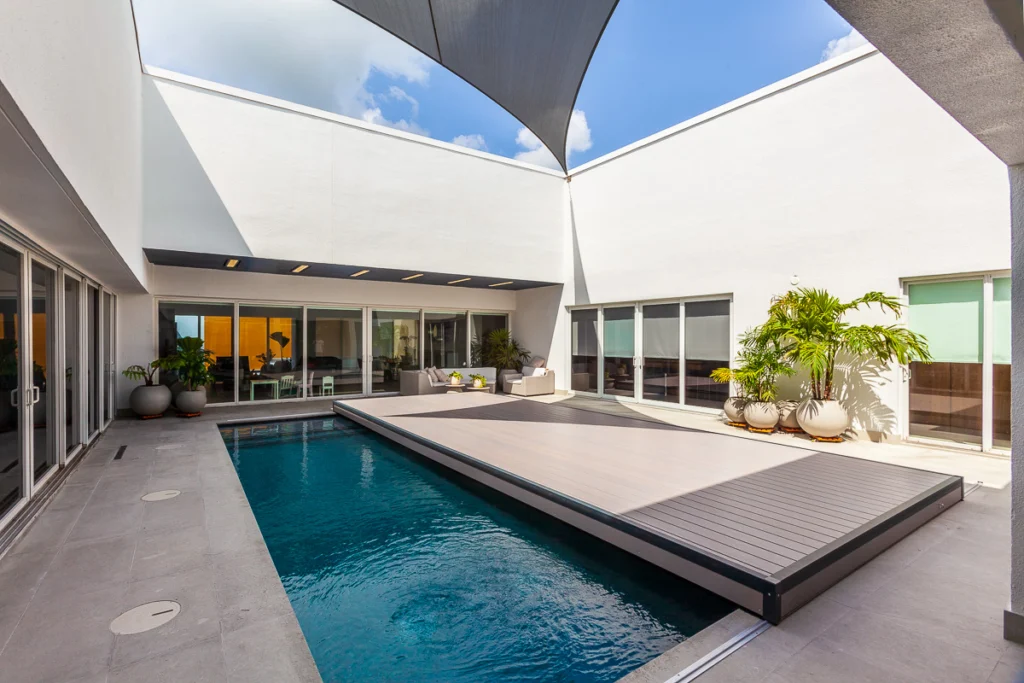
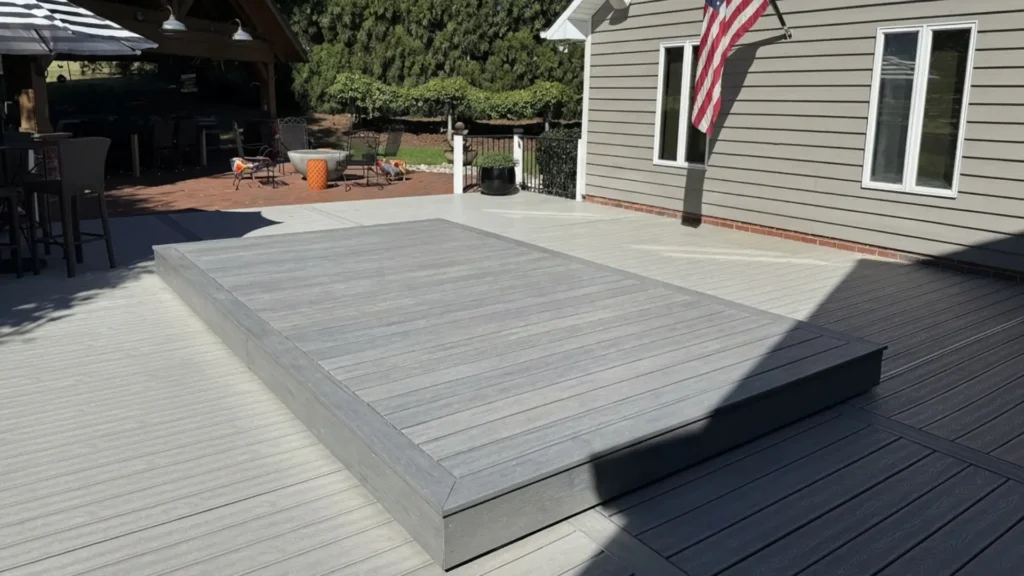
A sliding deck pool cover solves a different problem. Instead of trying to follow every curve of the waterline, it can cover the pool as a usable deck or patio surface. For some difficult pool shapes, this may be more practical than forcing a fabric cover to follow complex geometry.
This is especially relevant for:
- Small backyards
- Urban or courtyard pools
- Plunge pools or compact luxury pools
- Homes where outdoor living space is limited
- Buyers who want the pool area to become usable space when closed
Cover Dream match: S-LIDE™ sliding deck pool cover
Cover Dream describes S-LIDE™ as a two-in-one sliding pool cover, patio, and deck solution that makes the most of pool-area square footage. The page states that the sturdy deck supports high loads and turns the pool into deck space for children, pets, and entertaining guests.
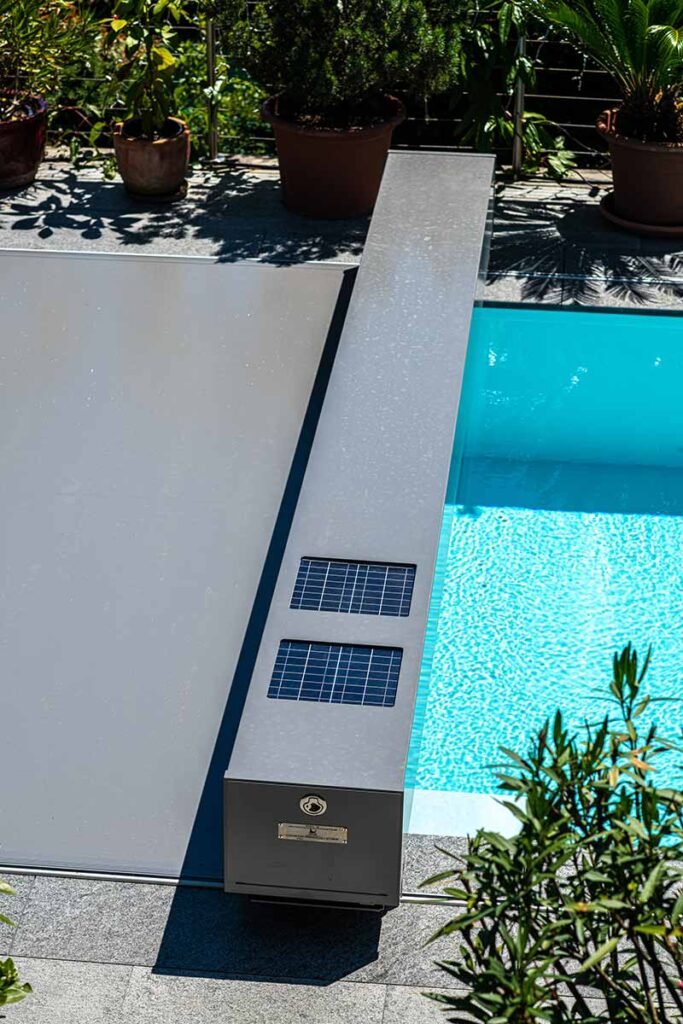
Cover Dream also states that S-LIDE can be configured with solar-powered motorized operation for push-button use, support patio furniture, and is available in various layouts to suit nearly any pool. That makes it highly relevant when the issue is not only “how do we cover this pool?” but “how do we make this pool area useful when the pool is closed?”
Best fit
- The primary goal is space optimization.
- The owner wants a pool-to-patio function.
- The pool shape makes a traditional cover difficult or visually undesirable.
- The design can accommodate the deck’s movement path.
Watchouts
- It is a premium structural solution, not a simple cover.
- It requires layout planning.
- It may not be the best choice if the only goal is low-cost heat retention.
- The surrounding deck area must allow the system to open and close properly.
For buyers with a pool cover for small backyard intent, S-LIDE is often worth evaluating early because it can change the pool area from a single-purpose water feature into flexible outdoor living space.
Option 3 — Retractable Pool Enclosures for Debris, Weather, and Season Extension
A retractable pool enclosure approaches the problem differently. Instead of covering only the water surface, it covers the pool environment. That can be valuable for freeform or complex pools where the waterline is difficult to cover cleanly, but the surrounding zone can be enclosed.
This is useful when the priority is:
- Debris control
- Wind and weather protection
- More comfortable swimming conditions
- Season extension
- Covering the pool area rather than following the exact edge shape
Cover Dream match: N-CLOSURE retractable pool enclosure
Cover Dream’s N-CLOSURE retractable pool enclosure page presents it as a telescopic pool enclosure that can fully cover or uncover the pool one module at a time or all together. The page states the system can be handled easily by one person and glides open on a frictionless aluminum track — solar heat is used passively to warm the water, not to power the movement.
For complex pools, the practical advantage is that an enclosure may reduce the need to follow every curve and edge detail of the waterline. It can be a better strategy when the design problem is not simply “cover the surface,” but “protect the whole pool environment.”
Best fit: the pool has heavy debris exposure; the owner wants more comfort and seasonal usability; a visible enclosure fits the design style; the shape is difficult for a surface-following cover.
Watchouts: enclosures are more visually present than low-profile covers; they require space and design acceptance; they may not match the aesthetic goal for every luxury pool; the enclosure footprint must be reviewed against landscape, deck, and property constraints.
Option 4 — Manual Trackless Safety Covers for Freeform Pools
Track planning is one of the biggest constraints for automatic covers on freeform or no-edge pools. A trackless system removes that constraint entirely by tensioning across the pool rather than running along a fixed rail. (This doesn’t change the picture for a vanishing-edge pool, which is outside what any Cover Dream system can cover.)
Cover Dream match: B-COVER manual safety cover. Where Coverseal relies on a track route, B-COVER has none to plan around: the cover tensions across the pool by hand using fiberglass support bars and a reinforced PVC membrane, independently rated for 500+ lbs and made to order for any pool shape. Skipping the track sidesteps exactly the routing problem that curves, raised spas, and irregular coping create for motorized systems.
Best fit: certified safety is the priority, but budget or geometry make a tracked automatic system impractical; the pool shape has tight curves or edge conditions that complicate track routing; manual daily operation is acceptable.
Watchouts: as a manual cover, it depends on the homeowner using it consistently; it does not offer the one-touch convenience of Coverseal or the space benefits of S-LIDE; very large or unusually shaped pools should still be reviewed for fit before assuming trackless removes every constraint.
Option 5 — Slatted Automatic Covers for Irregular Shapes
A slatted automatic cover approaches complex geometry differently than a membrane cover: rigid slats roll across the pool rather than a single tensioned sheet. Cover Dream positions this system specifically for out-of-standard pool shapes.
Cover Dream match: S-ROLL slatted automatic cover. S-ROLL runs on PVC or polycarbonate slats that roll into place on solar power, with an optional solar-heating slat available for buyers who also want passive water heating. Made to order for any pool shape, it’s a system Cover Dream markets specifically as a fit for out-of-standard geometries.
Best fit: the pool shape is unusual, but the buyer wants automatic operation rather than a manual solution; passive solar heating is a priority alongside evaporation control; a safety-cover rating is not the primary requirement (S-ROLL is a non-safety cover).
Watchouts: because S-ROLL is not a certified safety cover, it should not be positioned as a substitute for Coverseal or B-COVER where drowning-prevention is the goal; as with any automatic system, track and housing routing for the slat mechanism should be reviewed for the specific pool shape before assuming fit.
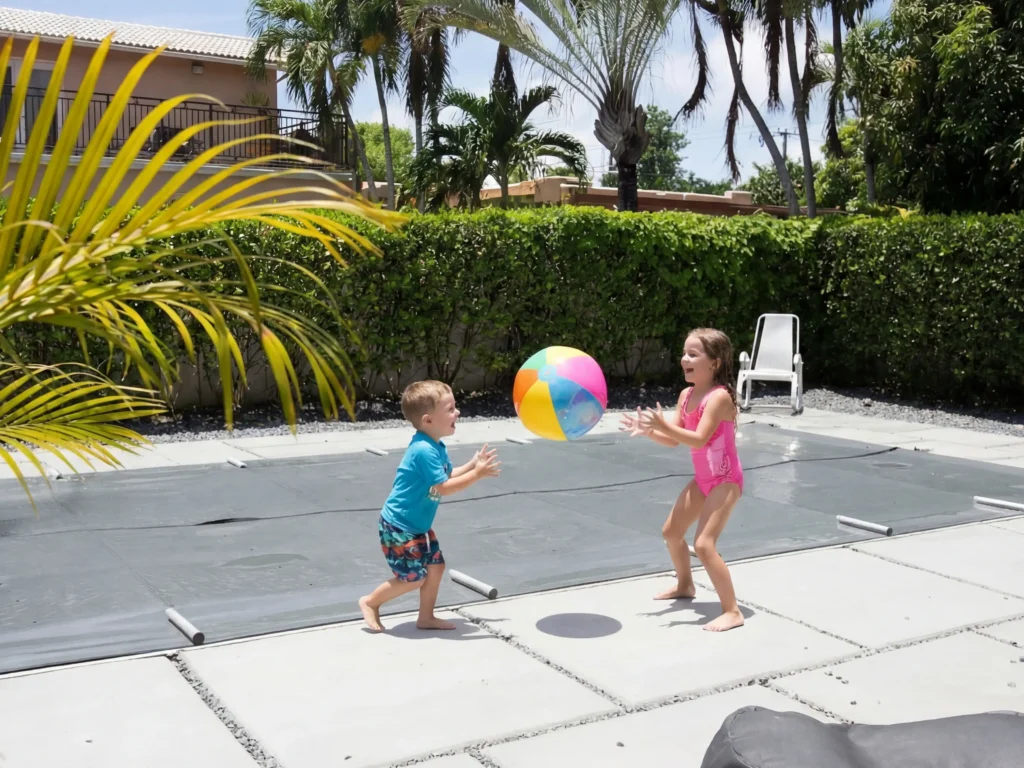
What Usually Does Not Work Well for Complex Pools
Some lower-cost cover types are useful, but they are limited. They should not be dismissed entirely, but they should be matched to narrow goals.
Under Track Automatic Pool Cover
An under-track automatic pool cover is a refined cover option where the tracks are concealed beneath the pool coping or integrated into the pool wall, creating a cleaner and more architectural appearance than standard deck-mounted tracks. This approach is most suitable for new pool construction or major renovations because the track system must usually be planned before the coping, deck, and cover housing are finalized. For homeowners who want automatic protection without visible track lines on the deck, an under-track system can offer a more seamless look while still supporting the everyday benefits of automatic pool coverage, including easier opening and closing, reduced debris, improved heat retention, and enhanced safety when correctly installed and used according to manufacturer instructions. The main tradeoff is planning complexity: under-track systems require precise design coordination, proper drainage, and enough structural space around the pool edge, so they should be evaluated early with the pool builder or cover specialist.
Solar blankets
A solar blanket can help reduce evaporation and retain heat, but it is not a safety cover and can be difficult to handle on freeform or irregular shapes. The U.S. Department of Energy explains that swimming pool covers reduce evaporation, and that covering a pool when not in use is the single most effective way to reduce pool heating costs.
However, a solar blanket does not solve the core design problems of complex pools: track integration, safety-barrier expectations, daily convenience, or premium aesthetics.
Generic tarps
Generic tarps are usually poor fits for complex pools because they do not integrate with tracks, edge conditions, or safety expectations. They may provide temporary debris coverage, but they should not be treated as a premium design or safety solution.
Leaf nets
Leaf nets can help during debris-heavy seasons, especially under trees, but they do not solve safety, water evaporation, heat retention, or daily convenience. They are narrow-purpose tools.
Low-cost seasonal covers
Seasonal covers can work for winterization or off-season closure, but they may not support the everyday lifestyle use that luxury pool owners expect. They also may not suit no-edge or flush-edge conditions without custom work, and none of these options solve for a vanishing-edge pool either.
For complex luxury pools, the cheapest cover often becomes the wrong cover if it does not align with the pool’s geometry, safety needs, or design intent.
Safety, Heat, and Maintenance Considerations
Safety
A safety-oriented solution should be evaluated against safety-cover expectations, not just material strength. ASTM F1346 describes a performance specification for safety covers and clarifies that the intended risk reduction depends on correct installation and use according to manufacturer instructions.
For complex pools, safety planning must consider:
- Edge gaps
- Track alignment
- Cover tension
- Locking or securing method
- Installer familiarity with the pool’s geometry
- How users will actually open, close, and maintain the system
This is why a pool cover for kidney shaped pool, or freeform pool should not be treated as a simple accessory. The cover should be evaluated as part of the design system. (Vanishing-edge pools are a separate case Cover Dream’s systems don’t address.)
Heat and evaporation
For heat, the most important principle is evaporation control. The U.S. Department of Energy states that covering a pool when it is not in use is the single most effective way to reduce pool heating costs, and that savings of 50%–70% are possible depending on conditions. Read the DOE guidance here: Swimming Pool Covers.
EPA WaterSense also states that using a pool cover can prevent up to 95% of pool water evaporation. The archived EPA WaterSense pool cover page notes that a typical uncovered pool can lose 12,000 to 31,000 gallons of water per year to evaporation, depending on location: EPA WaterSense Pool Covers.
Maintenance
A cover only performs if it is used consistently. For complex pools, ease of use becomes a major factor. A technically effective cover that is difficult to deploy may not deliver consistent real-world benefits.
This is where automatic systems, sliding deck systems, and enclosures become relevant. Each reduces friction in a different way:
- Automatic cover: quick daily closure
- Sliding deck: space and closure combined
- Enclosure: protected pool environment
The best solution is not always the most technically advanced. It is the system that matches the pool, the site, and the owner’s actual habits.
Design Checklist Before Requesting a Quote
Use this checklist before requesting a quote for a custom pool cover for irregular pool designs.
Pool geometry
- Pool shape and exact dimensions
- Freeform curves, kidney shape, or unusual angles
- Vanishing-edge (infinity-edge) or overflow edge, if present — flag this early, since it’s not something Cover Dream’s systems currently cover
- No-edge / flush-edge detail
- Raised spa, ledge, bench, steps, or integrated features
Deck and site
- Deck width around all sides
- Deck material and condition
- Available space for cover housing
- Access for installation equipment
- Existing landscaping, walls, fences, or tight side yards
Technical preferences
- Track visibility preference
- Concealed vs visible mechanism
- Electrical access
- Drainage / overflow conditions
- Desired opening/closing routine
- Whether the project is a new build or retrofit
Project context
- Design drawings or photos
- Target installation timeline
- Top priority: safety, heat, debris, or space
- Whether the cover should support daily use, seasonal use, or visual integration
The better your inputs, the more accurate the quote will be. For complex pools, photos alone are rarely enough; measurements and edge details matter.
Conclusion — The Best System Depends on the Pool and the Goal
Complex pools are not automatically “uncoverable.” But they do require a more strategic cover selection process.
If your priority is safety and daily use, evaluate an automatic safety pool cover such as Cover Dream’s Coverseal™, with careful attention to track strategy and pool geometry.
If your priority is space optimization, evaluate S-LIDE™ sliding deck pool cover, especially when the pool footprint could become a usable patio or entertaining space.
If your priority is debris, comfort, and season extension, evaluate N-CLOSURE retractable pool enclosure, especially when covering the pool environment makes more sense than following every edge of the waterline.
If your priority is certified safety without track constraints, evaluate B-COVER manual trackless safety cover, especially for pools where routing a motorized track is impractical.
If your priority is automatic operation and passive solar heating on an irregular pool shape, evaluate S-ROLL slatted automatic cover, which Cover Dream positions for out-of-standard geometries.
If your pool is freeform, no-edge, kidney-shaped, or highly customized, request a quote with dimensions, photos, edge details, and your primary design goal. (Note: vanishing-edge/infinity-edge pools fall outside what Cover Dream’s Signature Series can cover.) A restrained next step is to provide your pool layout, measurements, and the outcome you care about most: safety, heat, debris control, or space.
FAQs
Yes, many freeform pools can be covered, but the track strategy and housing placement matter. Latham notes that nearly every pool shape can be protected with an automatic cover, while emphasizing that the track option is often the key design decision. Learn more from Latham’s guide to automatic pool covers for every pool shape.
No. None of Cover Dream’s systems — Coverseal, B-COVER, S-LIDE, S-ROLL, or N-CLOSURE — are designed to accommodate a vanishing-edge pool (also called an infinity-edge pool), where water overflows a negative edge into a catch basin. That configuration falls outside Cover Dream’s current product line. If your pool has this feature, confirm with a dealer before requesting a quote.
A kidney-shaped pool usually requires a custom evaluation. An automatic cover may work if the track route is appropriate, while a sliding deck may be more practical if space conversion matters. The right choice depends on shape, deck width, housing placement, and goal priority.
A no-edge pool cover is not one single product type. It refers to a cover strategy for pools with flush or minimal-edge coping, where the deck sits level with the water. These designs require careful review because drainage, track placement, and housing visibility may be more difficult than on a standard pool. This is different from a vanishing-edge (infinity-edge) pool, which has a negative overflow edge — that configuration is outside what Cover Dream’s systems can cover.
It can be, especially when the main goal is space optimization. A sliding deck does not need to follow every curve in the waterline in the same way a surface cover might. Cover Dream describes S-LIDE as a two-in-one sliding pool cover, patio, and deck solution.
They can be a strong option when the goal is covering the pool environment rather than matching the exact waterline. Cover Dream describes N-CLOSURE as a telescopic enclosure that can cover or uncover the pool module by module or fully.
Often, yes. Complex shapes can require more design review, custom fitting, track planning, deck work, and installation coordination. Cost depends on whether the project is a new build or retrofit and whether the solution is an automatic cover, sliding deck, or enclosure.
Send pool dimensions, photos from every side, deck width and material, edge type, raised spa/ledge/step details, electrical access, and your top priority. For complex pools, design drawings or plans are especially helpful because edge and track details drive feasibility.
A solar blanket may help reduce evaporation and heat loss, but it is not usually a premium design solution or safety cover. The U.S. Department of Energy explains that pool covers reduce evaporation, but practical effectiveness depends heavily on consistent use. See DOE’s guide to swimming pool covers.
Start with your primary goal. For safety and daily automatic closure, evaluate Coverseal™. For reclaiming backyard space, evaluate S-LIDE™. For debris, comfort, and season extension, evaluate N-CLOSURE. For certified safety without track constraints, evaluate B-COVER. For automatic operation and passive solar heating on an irregular shape, evaluate S-ROLL. Complex pools should always receive quote-specific review before choosing a system.
